Skip to content

Journal Art Tips
Why Galleries Reject Artists: They Check Your Audience First
Why galleries reject artists without looking at the work, and how to build the small audience that gets your gallery pitch a reply instead of silence.


In this article 6 sections
- Why do galleries reject artists without really looking at the work?
- What are galleries actually looking for in an artist?
- Does the size of your following matter to a gallery?
- How do you build an audience before you pitch a gallery?
- How do you show a gallery that people care about your work?
- Should you stop working on your art and focus on your audience?
If you have been emailing galleries and hearing nothing back, you have probably reached the same conclusion most artists reach. The work is not good enough yet. So you go back to the studio, rework the paintings, and send the same kind of email again a few months later.
In most cases, that is the wrong diagnosis. Galleries are almost never rejecting you because of the quality of your work. Most of the time they never properly looked at it. Before a gallery seriously considers an artist, it checks one thing first: can this person already get attention without us?
I first talked about this in a video on Instagram, and I want to go further here. Why galleries think this way, what they are actually looking for, and how to build the proof they need before your next pitch.
Why do galleries reject artists without really looking at the work?
Think about it from the other side of the desk. A gallery is a business. It has rent to pay, staff to pay and walls to fill with work that sells. When a gallery takes you on, it is placing a bet that it can sell your work to its collectors. Every new artist is a risk, and a gallery is always looking for the thing that makes that risk smaller.
The single biggest thing that lowers that risk is you turning up with people who already care. That is why a gallery is not looking for the best painter in the pile. It is looking for someone who already has a small crowd standing around them, because that crowd is who it sells to.
This is not cynical. It is simply how a commercial gallery survives. But it changes how you should read the silence. When a gallery does not reply, it is rarely a verdict on your talent. It usually means they could not see any demand, so the conversation never got as far as the work.
What are galleries actually looking for in an artist?
They are looking for demand they can see. In practice, that means an audience. Not a famous name, not a long list of awards, but visible evidence that people already want what you make.
This is why two artists with exactly the same skill can get completely different answers from the same gallery. One built an audience before they ever walked through the door. The other waited to be discovered. The gallery picks the one who has already proved that people want the work, because that artist has done half of the selling before the first show is even booked.
When you message a gallery with nothing behind you, no following, no mailing list, no one who shows up when you post, the gallery has nothing to go on except your images. And no demand it can see means no, almost every time. It has nothing to do with whether the paintings are good.
Does the size of your following matter to a gallery?
The word I keep coming back to is small. You do not need a huge following to get a gallery’s attention. What a gallery wants to see is that some people genuinely care about your work and respond to it.
That care can show up in different ways:
- People who comment on your work, ask questions and come back to see what you make next.
- A mailing list of people who chose to hear from you, even if it is modest.
- Collectors or friends of the work who have bought from you directly.
- People who turn up in person when you show work, whether that is an open studio, a group show or a small pop up.
- Enquiries about pieces, commissions or when new work is coming.
Any one of these tells a gallery that you are not starting from zero. Together they tell a gallery that there is a crowd it can sell to. A small, engaged audience is proof of demand. A number on its own, with nobody behind it, proves far less.
How do you build an audience before you pitch a gallery?
If you have been pitching and hearing nothing, stop reworking the paintings for a moment. The work might already be ready. What is missing is the proof that anyone is watching. So build the smallest version of that crowd first. Here is where I would start.
Show up somewhere consistently. Pick one platform where people who might buy your work already spend time, and post there regularly. Share the work, but also share how it is made and who is making it. People follow a person as much as a portfolio, and an audience that knows you is far more likely to care what you do next.
Start a mailing list now. Social media followers belong to the platform. Email addresses belong to you. Even twenty people who asked to hear about new work are a real audience, and a list is something you can describe clearly to a gallery.
Give people a reason to turn up. An open studio, a small exhibition with other artists or an evening showing a new series all turn quiet followers into people who have stood in front of your work. That is exactly the kind of crowd a gallery wants to borrow.
Keep a simple record. Note your sales, enquiries, commissions and the people who came to your events. When you pitch, you want to be able to point to real evidence rather than a vague sense that people like your work.
None of this needs to be big before it counts. The point is to have something a gallery can see.
How do you show a gallery that people care about your work?
Once you have the beginnings of an audience, make it visible in your pitch. Most artists leave this out entirely because it feels awkward, or because they assume the work should speak for itself. To a gallery, leaving it out just looks like there is nothing there.
Keep it short and factual. A line on where you have sold, how people respond to new work, the size of your mailing list or who came to your last open studio is enough. Link to the place where your audience actually lives so the gallery can see it for themselves. Never inflate anything. A clear, true picture of where you are is far more useful to a gallery than claims it cannot check.
Audience is one part of a wider picture a gallery weighs up. If you want the full structure, I break down the other layers in my guide on how to pitch an art gallery, including how to fit all of them into one email.
Should you stop working on your art and focus on your audience?
No. The work still has to be there, and it still matters more than anything else to you. What changes is the order in which you think about it when you pitch.
For you, the art comes first. For a gallery, the audience comes first. Both things are true at the same time, and the artists who get a yes are the ones who understand both sides. Keep making the work. But if your response to every silent inbox has been to go back and repaint, try building the crowd instead, and see what happens to the same email you sent before.
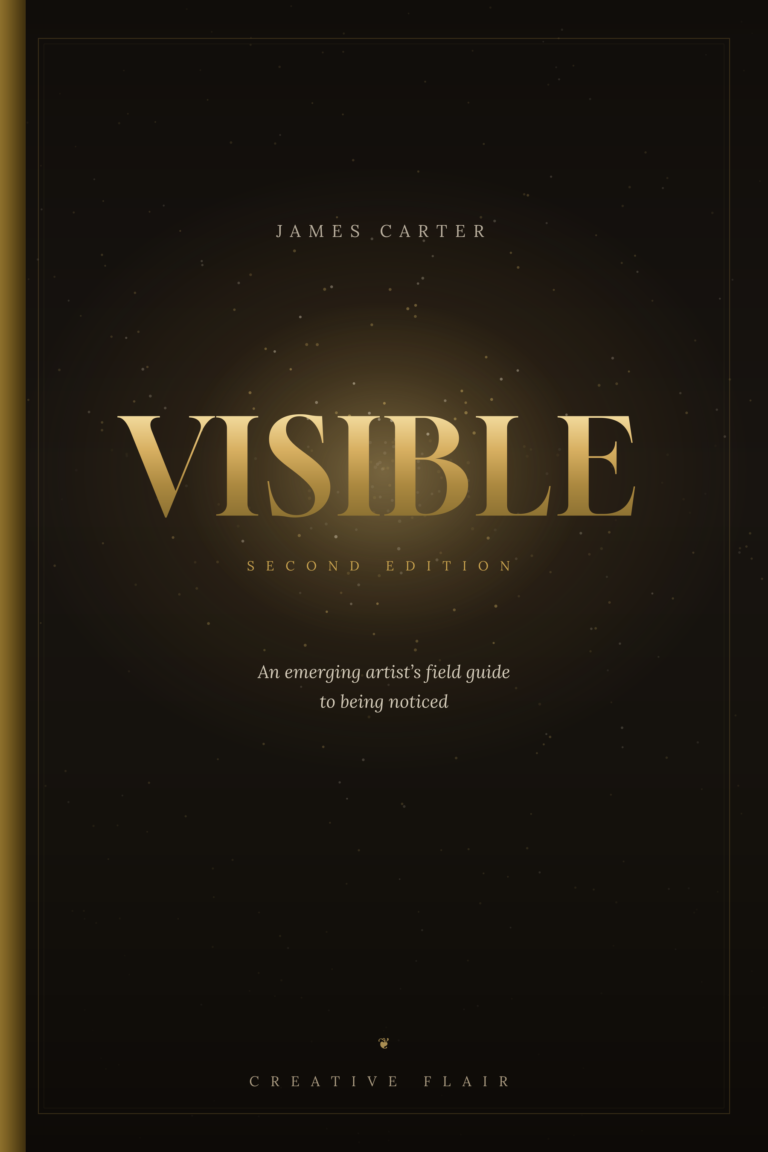
Building the audience that makes galleries say yes is a big part of what I cover in my book, VISIBLE, if you want the whole system for getting your work seen.
Galleries are not ignoring your work. They are checking for the people around it. Get that the right way round, build the smallest version of that crowd, and the doors that felt shut start to look a lot more open.