 Skip to content

Most artists pitch a gallery and never hear back. They send the email, attach the images, wait a few weeks, and then quietly decide that the work must not be good enough. Usually that is the wrong conclusion. The problem is rarely the work itself. The problem is that they are pitching the wrong thing.
When a gallery looks at a pitch, it is weighing up four layers. I think of them as a pyramid. Most artists only ever show the bottom layer, and then wonder why nothing happens. I first talked about this in a video on Instagram, and I want to go further here, layer by layer, with practical steps you can use before you send your next pitch.
What do galleries look for when an artist pitches?
Galleries evaluate four things when you approach them. From the base of the pyramid to the top, they are:
- The work. What you actually make.
- The market. Your pricing, your sales and whether there is demand.
- The story. Your statement, your positioning and why this body of work matters now.
- The momentum. What you are doing next and where you are heading.
Every artist leads with the work, and that makes sense. It is the thing you have spent years on. But the work is only the foundation. A gallery is a business deciding whether to put its name, its walls and its collectors behind you. It needs to see the whole structure, not just the base.
The artists who get a yes are the ones who show all four layers in one conversation. Not across six emails. Not over a year of hoping someone notices. In one pitch, clearly and simply.
Is the work enough to get into a gallery?
The work is necessary. Without it there is nothing to sell, and no amount of positioning will cover weak or unfinished work. So get this layer right first.
In practice, that means showing a consistent, resolved body of work rather than a little bit of everything. A gallery wants to understand what it would be selling. If your images jump between styles, subjects and mediums, the person reading your pitch has to do the hard work of figuring out who you are, and most of them will not.
Some simple steps for this layer:
- Choose a tight selection of pieces from one coherent series rather than your entire archive.
- Use clean, well lit, straight on photographs with accurate colour.
- Label every image with title, medium, dimensions and year.
- Make sure your website shows the same body of work, so anyone who clicks through sees a consistent picture.
Then stop. Do not let the pitch end here. This is where most artists stop, and it is exactly why most pitches go nowhere.
Why does a gallery care whether your art sells?
The second layer is the market. Have you sold pieces? At what price points? Is there demand for what you make?
Galleries are not charities. They have rent, staff and shows to pay for, and they make their money by selling art. When they take on an artist, they are making a commercial decision as well as an artistic one. What they need from you is commercial signal: evidence that people already want to buy your work.
Many artists leave this out entirely, either because it feels awkward to talk about money or because they assume the gallery will not care. Leaving it out does not make you look more serious. It just leaves a gap that the gallery has to fill with guesswork.
How to show this layer honestly:
- Know your price points and state them plainly. A gallery needs to see that your pricing is considered and consistent.
- Mention where you have sold, whether that is through your website, open studios, commissions or previous exhibitions.
- If people are waiting for new work, or regularly asking about pieces, say so.
- Keep it factual. You do not need to inflate anything. A clear, true picture of where you are is far more useful to a gallery than vague claims.
If you are early on and have not sold much yet, start building this layer now, before you pitch. Every sale, every commission and every collector who comes back is part of the signal a gallery is looking for.
How do you explain your art so a gallery can sell it?
The third layer is the story. This is your statement, your positioning, and your answer to a simple question: why this body of work, now?
Think about what a gallery actually does with you once it says yes. It stands in front of a collector and tries to explain why your work matters. The story layer is the frame that lets a gallery sell you in one sentence. If the gallerist cannot repeat your story easily, they cannot sell it.
This is where a lot of artist statements fall down. They are written to sound clever rather than to be repeated. A gallery does not need a dense paragraph of theory. It needs a clear idea it can pass on.
To strengthen this layer:
- Write one sentence that explains what the body of work is about and why you are making it now.
- Test it out loud. If you would not say it to a stranger at a private view, rewrite it.
- Make sure your statement, your website and your pitch all tell the same story.
- Connect the story to the specific series you are pitching, not to your entire practice in general.
What is momentum, and why does it matter to galleries?
The top of the pyramid is momentum. What are you doing next? What shows do you have planned? Which curators are you talking to? In short, what is your trajectory?
A gallery is not only buying into what you have done. It is buying into where you are going. An artist with clear plans looks like someone worth investing time in, because the gallery can see that its support will build on something already moving.
Momentum does not have to mean anything grand. It means showing that your career has direction:
- Upcoming exhibitions, residencies, open studios or projects that are confirmed.
- Conversations you are genuinely having with curators or other spaces.
- The next body of work you are developing and when it will be ready.
Only include what is real. Overstating your plans is the quickest way to lose trust.
How do you put all four layers into one gallery pitch?
Here is the shift. Instead of sending a gallery your work and hoping it speaks for itself, you build a pitch that climbs the whole pyramid in a few short paragraphs.
A simple structure looks like this:
- Open with the story. One sentence on what the body of work is and why it matters now.
- Show the work. A small, consistent selection of images with full details, plus a link to your website.
- Give the market signal. Your price range and a clear, honest line on where and how your work has sold.
- Finish with momentum. What is coming next for you, with dates where you have them.
Keep it short. Each layer might only be a sentence or two. The point is not to write more. The point is to make sure nothing is missing. If you want a starting point for the wording, my guide on how to email a gallery about your art gives you a template you can adapt around these four layers.
Before you send it, read your pitch back and ask four questions. Can they see the work? Can they see that it sells? Can they repeat my story? Can they see where I am going? If any answer is no, fix that layer first.
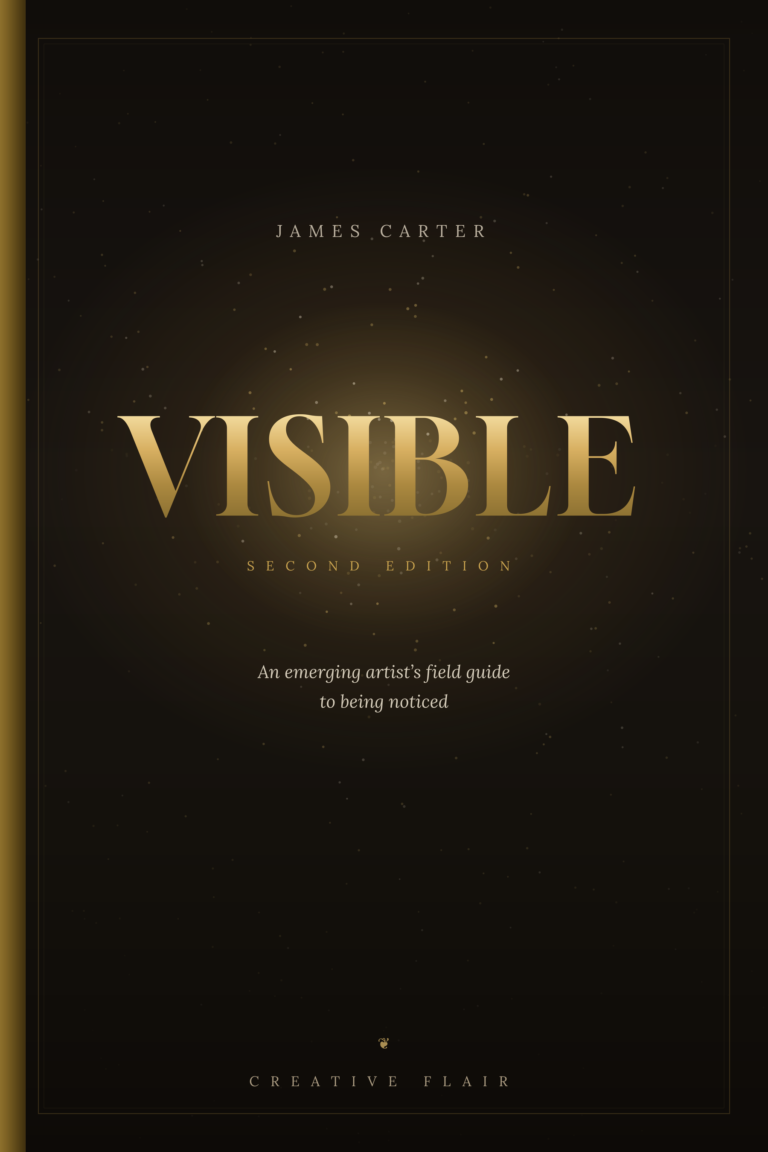
There is a whole chapter on this pitch architecture in my book, VISIBLE, if you want to go deeper into how to structure your approach to galleries.
The artists who get a yes
Most artists pitch only the bottom layer, just the work, and take the silence personally. The artists who get a yes are not always the most talented in the pile. They are the ones who make it easy for a gallery to say yes, by showing the work, the market, the story and the momentum together. Build all four layers, then pitch. And if you know an artist who has been pitching just the work, send this to them.
You do not have to wait to be found.
VISIBLE covers the part nobody teaches: how galleries, open calls, pricing, audience and money actually work, and what to do about each one. 234 pages, with twelve worksheets you fill in and use.
- Rated 4.8 from 5 reviews
- 610+ artists have a copy
- Instant download, PDF and workbook
Usually




Responses