
If I had to start over as an artist tomorrow, with no following, no gallery and no contacts, I know exactly what I would do, and in what order.
Most artists who feel stuck are not short of talent. They are short of a plan. They make good work, post it now and then, wait for someone important to notice, and slowly decide that the art world is closed to them. It is not closed. It just does not reward waiting.
I first talked about this in a video on Instagram, and because it puts the whole system in one place, I wanted to write it out properly. Here is the full roadmap, five steps plus one mindset that runs through all of them, with practical advice for each.
What should I make first if I am starting my art career from scratch?
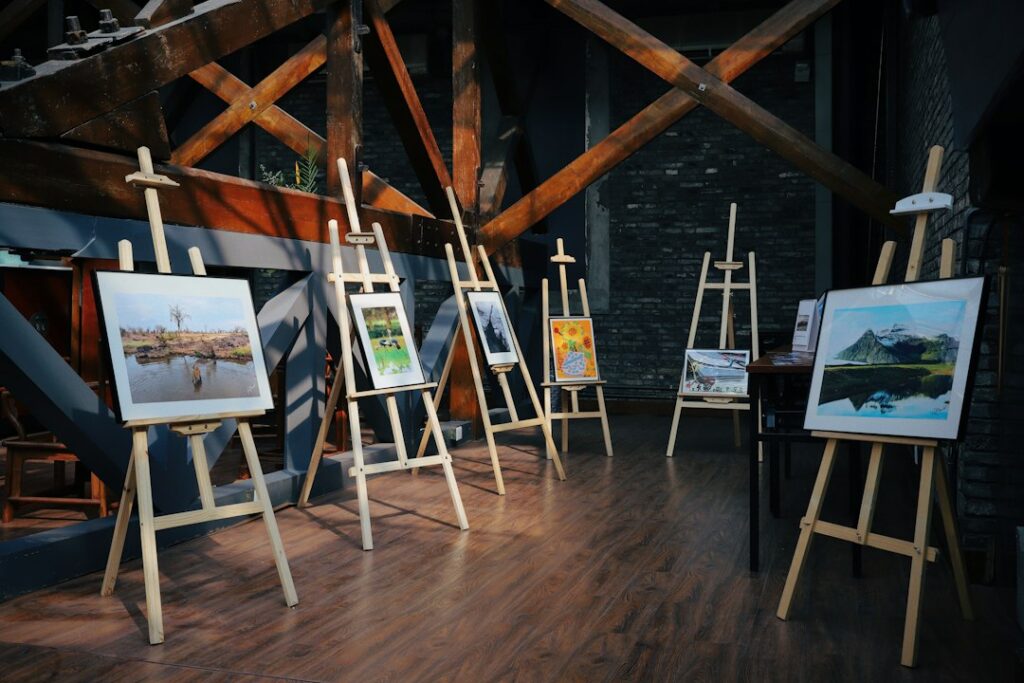
First, I would stop making random one off pieces and make a body of work. That means a group of pieces that clearly belong together, so anyone who finds me instantly understands what I am about.
Scattered work is forgettable. A body of work is a brand. When someone lands on your page and sees a landscape, then a portrait, then an abstract, then a still life in a completely different style, they have nothing to hold on to. When they see ten pieces that share a subject, a palette or a question, they get it in seconds, and that recognition is what makes them remember you.
To build one:
- Look at what you have already made and find the thread you return to most often.
- Choose a subject, a medium and a rough size, and commit to them for a set number of pieces.
- Aim for somewhere around ten to twenty works that could hang together on one wall.
- Give the series a name. It makes the work easier to talk about and easier to share.
You can still experiment. Just keep the experiments separate from what you put in front of the public.
How often should artists post their work online?
Second, I would get the work online and post consistently, both my work and my face. Not perfectly. Just regularly.
The artists who get seen are not the most talented. They are the most visible, and visibility is a habit, not a talent. Someone who posts every week for a year will almost always build more of an audience than someone who posts a masterpiece twice a year and then disappears.
Showing your face matters as much as showing the work. People connect with the person who made the painting, not only with the painting itself. That can feel uncomfortable at first, which is fine. You do not need to be polished. You need to turn up.
Practically, pick a rhythm you can keep for months rather than one you can keep for a fortnight. Decide which days you post, batch your photos and short videos when you are in the studio, and share the process as well as the finished piece. A half finished canvas often says more about you than the final result.
How do I make my art easy to buy?
Third, I would make my work stupidly easy to buy. One clear page, a price, and a way to pay in two taps.
Every extra click between someone loving your work and owning it costs you the sale. If a person has to message you to ask the price, wait for a reply, then send a bank transfer, many of them will simply give up somewhere along the way. Not because they did not want the work, but because the process asked too much of them.
Go through your own buying journey as if you were a stranger:
- Can someone find the available work within one click of your homepage or bio link?
- Is every piece clearly priced, with size and medium listed?
- Can they pay on the spot, on a phone, without creating an account?
- Is it obvious how shipping or collection works?
If the answer to any of these is no, fix that before you do anything else to promote the work. Visibility without an easy way to buy just sends people to a dead end.
Where do artists actually find buyers?
Fourth, I would go straight to the people who actually buy and show art, instead of waiting to be discovered. Interior designers, local businesses, open calls and grants.
The idea of being discovered is comforting because it puts the responsibility on someone else. In practice, most opportunities go to the artists who ask for them. So I would knock on ten doors a week and let the numbers do the work.
Ten doors could look like this: three emails to interior designers or local businesses whose spaces suit your work, three open call applications, two grant applications, and two follow ups from previous weeks. Keep a simple spreadsheet so you know who you have contacted and when to follow up. Most of the doors will stay shut. That is normal. The point is that over months, enough of them open.
If you want to understand one of these routes in more depth, I wrote about how art consultants find artists for hotels and offices, which is a market many painters never think to approach.
How do I talk about my art so people care?
Fifth, I would learn to talk about my work so people care. A first line that hooks, a story that means something, in plain human words.
Nobody buys what they do not understand. If your captions, your website and your artist statement are written in dense art speak, you are making people work hard just to know what they are looking at. Most will not bother.
Start with the first line. Whether it is a caption, an email to a designer or what you say at a private view, the opening sentence decides whether anyone keeps listening. Then give them the reason the work exists: the question you keep returning to, the thing you cannot leave alone. That story is the part people remember and repeat to someone else.
Practise out loud. Explain one piece to a friend who knows nothing about art and notice where they lose interest. Rewrite until they do not.
What if I do not feel ready yet?
Through all five steps, I would start before I felt ready, because ready never actually comes.
There will always be a reason to wait: the body of work is not big enough, the website is not finished, the photos are not quite right. Those reasons can stretch out for years. The artists who move forward are the ones who accept being seen doing it badly at first, and improve in public.
That is the whole game. Not talent. Visibility, plus the courage to be seen doing it badly at first.
Each of these five steps deserves far more than a few paragraphs, and the full version of this roadmap is what my book VISIBLE covers, step by step.
If you are starting from nothing, start here: a body of work, a regular habit of showing it, an easy way to buy it, ten doors a week, and plain words that make people care. Pick the step you have been avoiding and do something about it this week. And if you know an artist who is brilliant but completely stuck, send this to them.
You do not have to wait to be found.
VISIBLE covers the part nobody teaches: how galleries, open calls, pricing, audience and money actually work, and what to do about each one. 234 pages, with twelve worksheets you fill in and use.
- 590+ artists have a copy
- Instant download, PDF and workbook
Usually

Responses