

There are five words showing up in almost every artist statement that are quietly killing galleries’ interest. I have read hundreds of statements over the last four years, and the same words keep appearing in the ones that do not land. If a gallerist opens your statement and sees them, there is a good chance they close the tab before they ever get to your work.
The five words are explore, liminal, investigates, practice and interrogates. I first talked about this in a video on Instagram, and the response told me just how many artists recognised their own statement in that list. So here is the longer version: what is wrong with each word, what to write instead, and how to fix your statement today.
Why do galleries ignore my artist statement?
Most statements are not ignored because the art is weak. They are ignored because the writing sounds exactly like everyone else’s. Every one of these five words started life as a real, useful word. Then it was used so often in art school statements that it stopped meaning anything at all. They have become the academic equivalent of stock photography: present in every statement, signalling nothing.
The deeper problem is what these words do to you as the writer. Each one lets you sound important without committing to anything specific. My work explores. My practice investigates. My research interrogates. These are sentences that promise meaning without delivering it, and the people reading them can feel it.
A gallerist reading your statement wants one thing: to understand quickly what you make and why it matters to you. Anything that delays that answer works against you.
Should I use the word “explore” in an artist statement?
No. “My work explores the liminal space between memory and form.” It does not. Explore is the word artists reach for when they do not yet know what their work is about. It promises a journey without committing to a destination.
Here is a simple test. Try replacing explore with a verb that actually says what you are doing. Explore might become ask, look at, paint, or return to. If you cannot find a replacement, that is useful information. It usually means the idea is not clear enough yet to be written down, and the honest next step is to spend more time with the work before you write about it.
Is “liminal” a bad word to use in an artist statement?
If you have used the word liminal in your artist statement, please remove it. I will wait.
Liminal used to mean something specific. Then it was taken up so widely in art education to mean “the bit between two things” that it now means almost nothing. Galleries see it constantly. It does not make you sound clever. It makes you sound the same as everyone else who submitted that week.
If you genuinely paint thresholds, doorways, dusk or the moment between sleeping and waking, then say that. Name the actual thing. The concrete version is always more memorable than the abstract label.
What is wrong with “investigates” and “interrogates”?
Investigates has the same problem as explore, just with a lab coat on. “My practice investigates.” Investigates what? Are you a detective? What did you find? If you investigated and did not reach a conclusion, you did not investigate. You looked around.
Interrogates is the political version. “My work interrogates power structures.” It does not. Your work might raise questions about power structures, but a painting cannot interrogate anything. Only a person can. Artists tend to use interrogates when they want their work to sound politically serious without committing to a political position, and galleries can feel that gap.
The fix for both is the same. Swap them for smaller, more direct words. Investigates can become show, argue or describe. Interrogates can become question, challenge or push back against. Then make sure the sentence says what you are actually questioning and what position, if any, you are taking.
Should I say “my practice” in an artist statement?
This one is a trap, because practice is a real word that artists use every day. The problem is that “my practice” in a statement usually stands in for something more specific you could have said. “My practice engages with” almost always means “I make”.
Use the smaller, more accurate word. I paint. I sculpt. I make. Specificity is what makes a statement read as though a real person wrote it. A sentence like “I paint people in the moments before they speak” tells a gallerist more in nine words than a paragraph about your practice ever will.
How do I rewrite my artist statement in plain language?
Look at all five words together and the pattern is obvious. They are words that sound like they mean something but actually let you off the hook from saying anything specific. The statement that lands is the one written by someone willing to say what their work is, in language they would actually use out loud.
Here is a practical way to do that today:
- Search your statement for the five words. Open the document and look for explore, liminal, investigates, practice and interrogates. Highlight every one.
- Ask what you actually meant. For each highlighted word, write down in plain terms what you were trying to say. Imagine a friend asked you across a table.
- Replace it with the smaller word. Explore becomes ask, look at or paint. Investigates becomes show, argue or describe. Practice becomes I paint, I sculpt, I make.
- Read it out loud. If a sentence sounds strange spoken aloud, it will read strangely too. Keep rewriting until it sounds like you talking about your work.
- Check that it commits. Every sentence should say something definite: what you make, what you are looking at, and why it matters to you. If a sentence could appear in anyone’s statement, cut it or make it yours.
The version you end up with will sound less academic and more like you. That is the version that works. It is also the version that holds up when you are asked about your work in person, which is exactly where a lot of artists stumble. If that is a moment you dread, I break it down in the five questions gallerists ask artists, and what they really mean.
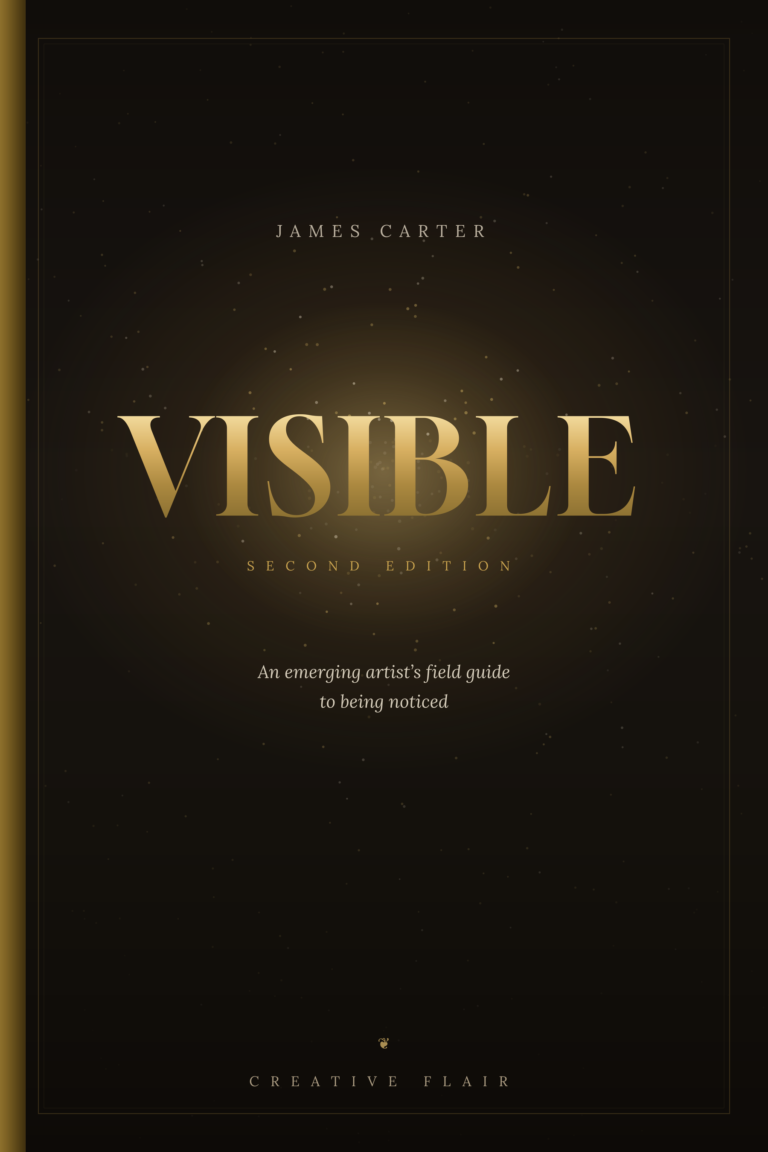
The fix is simple but uncomfortable, because plain language leaves you nowhere to hide. That is the point. If you want the full framework for writing a statement that sounds like a real person rather than a seminar handout, it is a chapter in my book VISIBLE.
Read your statement right now. If any of those five words are in there, replace them with what you actually meant. And if you know an artist who has been rewriting their statement for six months, send this to them. Sometimes all it takes is reading it once with fresh eyes.
You do not have to wait to be found.
VISIBLE covers the part nobody teaches: how galleries, open calls, pricing, audience and money actually work, and what to do about each one. 234 pages, with twelve worksheets you fill in and use.
- 590+ artists have a copy
- Instant download, PDF and workbook
Usually
Responses