
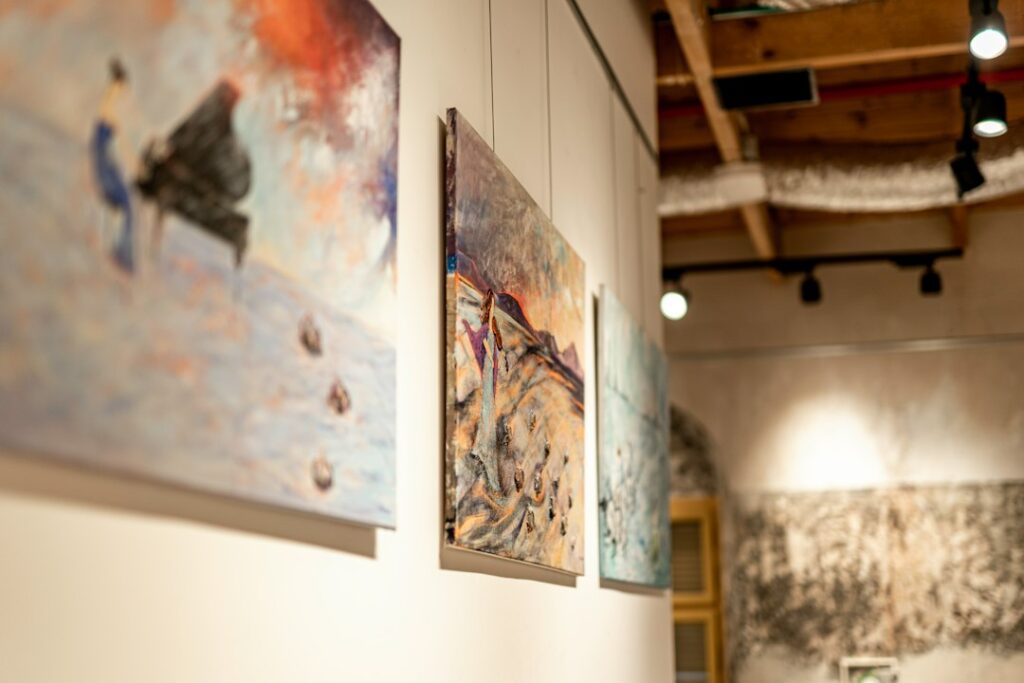
A gallerist walks up to you at an opening and asks what your work is about. You have about ten seconds. What you say next decides whether they remember you or politely move on to the next person with a glass of wine in their hand. Most artists blow it.
It is not because their work is weak. It is because nobody ever taught them how to talk about it out loud. We spend years learning to paint, draw or sculpt, and maybe a few weeks agonising over a written statement, but almost no time practising the one conversation that actually happens in the room. I first talked about this in a video on Instagram.
So here is how to get those ten seconds right.
Why does talking about your art feel so hard?
Writing gives you time. You can draft, delete and polish. Speaking does not. When someone asks you directly, in person, there is no backspace key, and the pressure pushes most of us towards one of two bad answers.
The first is to reach for borrowed language. The second is to panic and say almost nothing. Both come from the same place: you have never decided, in plain words, what your work is. Until you have, every question about it will feel like an exam you did not revise for.
The good news is that knowing how to talk about your art is a skill, not a talent. You can prepare for it in an evening, and once you have done the work, you will have an answer you can give anywhere: at an opening, at an art fair, in a studio visit or to a stranger at a dinner party.
What should you never say when a gallerist asks about your work?
Start with what kills the conversation, because avoiding these two traps is half the battle.
Trap one: art school language. Do not say your work explores the relationship between memory and material. Do not say it interrogates liminal space. The second you reach for that kind of phrasing, their eyes glaze over and they start looking for the exit. It sounds clever in your head, but out loud it tells the listener nothing. They cannot picture the work, they cannot repeat it to anyone else, and they certainly cannot remember it an hour later.
Trap two: the freeze. The opposite mistake is just as damaging. The nervous “oh, I do not really know how to describe it” might feel modest, but to a gallerist it suggests there is no thinking behind the work. They are not looking for a lecture, but they do want to know that you understand what you are making and why.
If you recognise yourself in either of these, you are in good company. The fix is simpler than you think.
What is the best way to describe your art in a few sentences?
Here is what to say instead. Three sentences. That is all you need.
One. What you actually make, in plain words. Name the medium and the subject as if you were describing it to a friend who has never been to a gallery. For example: “I paint big portraits of strangers I meet on night buses.” Anyone hearing that can picture it immediately.
Two. What it is really about, the human part. This is the reason the work exists, said in ordinary language. Following the same example: “It is about how people drop their guard when they think no one is watching.” Notice there is no theory here. It is a human observation that the listener can connect to their own life.
Three. What you are making right now. This tells the gallerist your practice is alive and moving. “At the moment, I am working on a series of people asleep on the last train home.” It also gives them an easy follow up question, which keeps the conversation going.
Plain. Specific. Human. That is the version a gallerist remembers.
Those three example sentences are just an illustration of the formula, not a script to copy. Your version should sound like you and describe your work, which is exactly why it will land.
How do you write your own three sentence answer?
Sit down with a notebook and work through the three parts one at a time. Here is a practical way to do it.
- Write sentence one without any adjectives at first. Medium, subject, scale if it matters. “I make small oil paintings of my kitchen table.” Once it is clear, you can add one detail that makes it vivid.
- For sentence two, ask yourself why you keep returning to this subject. Write down every honest answer, even the ones that feel too simple. The simple ones are usually the best. If you catch yourself writing words like “explores”, “interrogates” or “negotiates”, cross them out and say what you actually mean.
- For sentence three, look at what is on your easel or workbench today. Describe the current series or piece in one line. If you are between projects, describe what you are about to start.
- Cut everything that does not need to be there. If a sentence takes more than one breath to say, it is too long.
If you already have a written artist statement, this is a good moment to check it against your spoken version. The two should feel like the same person talking. If the written one sounds far grander than what you would say out loud, the spoken one is probably closer to the truth.
How do you practise talking about your art so it sounds natural?
Having three good sentences on paper is only the start. The point is to be able to say them calmly when your heart is racing at an opening. That takes practice.
Say it out loud until it is yours. Read it to yourself, then say it without looking. Do it while you wash your brushes or walk to the shops. The aim is not to memorise a speech word for word, but to know the shape of your answer so well that you can say it in slightly different ways depending on who is asking.
Record yourself. Use your phone and listen back. You will hear immediately where you rush, mumble or slip back into jargon. Adjust and try again.
Try it on real people. Tell a friend, a family member or another artist. Watch their face. If they ask a follow up question, that is a good sign: your answer opened a door rather than closing it.
Keep it current. Sentence three will change as your work develops. Update it whenever you start a new series so your answer always reflects what you are doing now, not what you were doing last year.
What happens after the first ten seconds?
Your three sentences are the opening, not the whole conversation. If the gallerist is interested, they will ask more, and that is where you can go deeper into process, influences or where the work is heading. Because you started in plain language, you have earned their attention for the rest.
It also helps to know the other questions that often come up when a gallerist is getting to know an artist. I have written about the five questions gallerists ask artists and what they really mean, which is worth reading alongside this so you are ready for the whole conversation, not just the first line.
Learning how to talk about your work, in the room and on the page, is a big part of my book VISIBLE, which sets out the full system for getting your art seen.
The next time someone asks what your work is about, those ten seconds are the whole opportunity. Write your three sentences tonight, say them out loud until they feel natural, and walk into your next opening knowing exactly what you will say.
You do not have to wait to be found.
VISIBLE covers the part nobody teaches: how galleries, open calls, pricing, audience and money actually work, and what to do about each one. 234 pages, with twelve worksheets you fill in and use.
- 600+ artists have a copy
- Instant download, PDF and workbook
Usually


Responses