Skip to content

Journal Art Tips
What to Post as an Artist When You Have Nothing Finished
Nothing finished to share? Here is what to post as an artist between paintings: five simple ideas that keep you visible without a single finished piece.

In this article 7 sections
- Why do artists go quiet between finished pieces?
- Should you post work in progress on Instagram?
- How do you repost old artwork without it feeling lazy?
- What should an artist say to camera?
- What can an artist teach on social media?
- How do you get followers to engage with your art?
- How often should you post when you are between paintings?
Most artists only post when they finish a piece. Then they disappear for two or three weeks while the next painting comes together, and in that gap something quietly goes wrong. The algorithm forgets them, and so does everyone who was just starting to pay attention.
I understand why it happens. Finishing feels like the only thing worth announcing, and posting anything less can feel like showing your workings before the answer is ready. But being seen is not about how often you finish work. It is about how often you show up. I first talked about this in a video on Instagram, and this is the longer version: five things to post when you have nothing finished, and how to do each one properly.
Why do artists go quiet between finished pieces?
Because most of us were taught to treat our feed like a gallery wall. Only the finished, framed, perfectly lit piece is allowed to go up. Everything else stays in the studio.
The trouble is that real work does not arrive on a schedule. A large oil painting can take weeks. A series can take months. If your account only moves when a piece is complete, it will spend most of its life standing still, and silence on social media reads as absence. People do not wait for you. They simply stop seeing you.
The fix is a change in what you think your account is for. It is not a shop window for finished objects. It is a record of a practice, and a practice is happening every single day, whether or not anything is signed. Once you see it that way, you will never run out of things to share. Here are the five I would start with.
Should you post work in progress on Instagram?
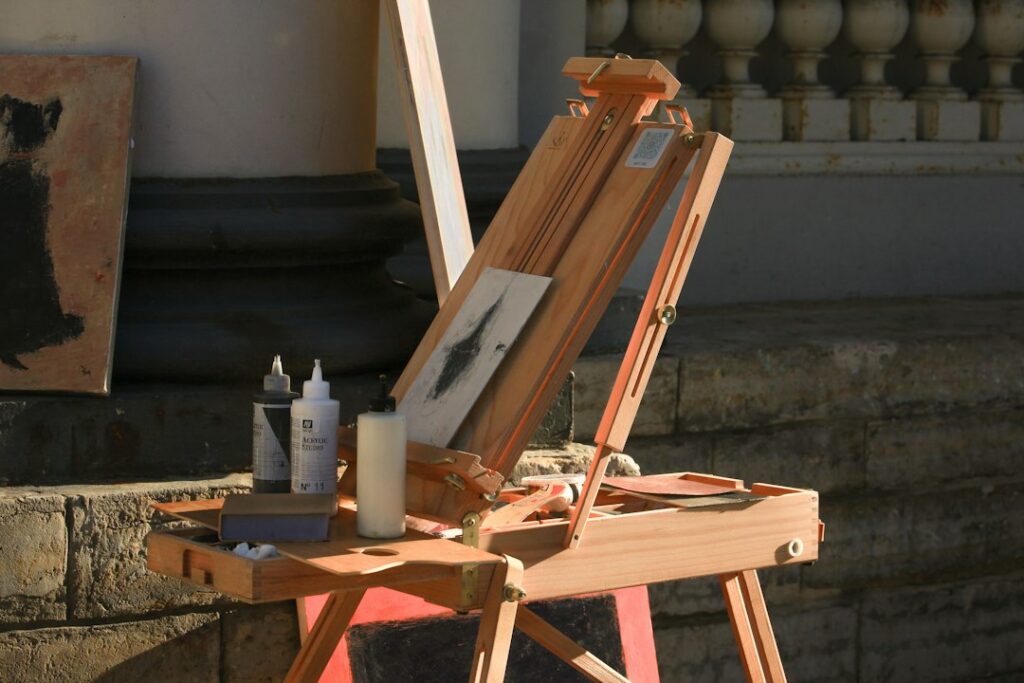
Yes, and it might be the most interesting thing you share. The underpainting. The ugly middle stage where nothing quite works yet. One corner of the canvas in close detail. People do not follow finished objects. They follow the making. The half done version is often more compelling than the final one, because it lets people see decisions being made.
To make this easy:
- Keep your phone near the easel and photograph the piece at the end of each session, from the same angle and in the same light, so the images build into a sequence.
- Get close. A detail of brushwork, a passage of colour or a single hand often stops the scroll better than the whole canvas.
- In the caption, say what you are deciding. Whether that background needs to go darker, or why the shadow is not right yet. That small window into your thinking is what turns a progress shot into something people care about.
How do you repost old artwork without it feeling lazy?
Bring an older piece back, but not as a lazy throwback with no context. Repost something from a year ago and tell people what you were trying to work out in it. What problem you were chasing, what you learned, what you would do differently now.
Your back catalogue is content. You just have to keep introducing it. Most of the people who follow you today were not there when you first shared that painting, so to them it is new. And for the people who were there, hearing what you were thinking gives them a reason to look again.
A simple way to start: go through your archive and pick three pieces that connect to what you are making now. Post one with a few honest lines about where it sits in your journey. That link between old and new work also helps people understand your practice as a whole, rather than as a set of unrelated pictures.
What should an artist say to camera?
Tell people why you make what you make. One honest line to camera about your subject, or about what keeps pulling you back to it. This is the post that actually grows you, because people follow the person, not just the work.
It does not need to be polished or long. In fact, it works better when it is not. A few practical pointers:
- Keep it to one thought. You are not reading out your artist statement. You are telling a friend why you care.
- Film it in the studio, with the work or your materials in shot, so the words and the practice sit together.
- Do not over script. Know the one sentence you want to land and let the rest be natural.
I have written more about this in how to get followers as an artist, because it is the single biggest shift most artists can make. The work gets attention. You are the reason people stay.
What can an artist teach on social media?
Teach one small thing. A material you love. A mistake you finally fixed. How you stretch a canvas. It does not have to be a full tutorial. One clear, useful idea is enough.
Teaching matters for a practical reason. When you teach, people save the post so they can come back to it, and saving is what tells the app to show you to more people. A finished painting gets admired. A useful tip gets kept.
If you are not sure what to teach, look at the questions people already ask you, or at the things you had to learn the hard way. For a painter that might be how you prepare a surface, why you choose a particular brush, or how you mix a colour you use often. Things that feel obvious to you are often exactly what someone else has been searching for.
How do you get followers to engage with your art?
Ask them something. Show two directions a piece could go and ask which one to chase. Two colour studies, two compositions, two crops of the same reference. Then let people tell you.
A pause in your own work is not dead time. It is a conversation you are not having yet. Asking a real question invites people into the process, and people who feel involved in a piece are far more likely to care when it is finished.
To make this work well:
- Keep the choice simple. Two options, clearly shown, is much easier to answer than an open question.
- Use a poll in your stories if you want quick answers, or ask in a caption if you want people to explain their choice.
- Reply to the answers, and then follow through. When the piece moves forward, show people which direction you took and why. That closes the loop and gives them a reason to keep watching.
How often should you post when you are between paintings?
Often enough that people do not forget you, and no more than you can sustain. The point of these five ideas is that none of them need a finished painting, so you always have something ready. Rotate through them across a week or two and you will find that the gaps between finished pieces start to fill themselves.
Staying visible when you have not just finished something is a big part of what my book, VISIBLE, is built around: the whole system for getting seen as an artist, not just making the work.
None of this needs a finished painting. It just needs you to stop vanishing between them. Pick one of these five, post it this week, and notice how different it feels to show up while the work is still happening.