

In 1907, a Swedish woman painted a row of enormous, glowing canvases swirling with spirals, snail shells and floating symbols. They look like something from the 1960s, all citrus colour and dreamlike geometry. Wassily Kandinsky is usually credited with inventing abstract art. Yet he would not paint his first non-figurative work for another three years or so. Her name was Hilma af Klint, and for most of the twentieth century almost nobody knew her paintings existed.
That is the strange, slightly maddening thing about her story. She got there first, then she hid the evidence. And only in the last decade has the wider world caught up with what she did.
Who was Hilma af Klint?
Hilma af Klint was born on 26 October 1862, the daughter of a Swedish naval commander. Her father was a keen mathematician. So she grew up around charts, diagrams and the idea that the universe might be readable through numbers. That early exposure mattered, because her later work is full of measured geometry rather than loose, accidental shapes.
In 1882 she enrolled at the Royal Academy of Fine Arts in Stockholm. It was one of the few institutions in Europe that admitted women at the time. She trained there for five years and was good at it. By the 1890s she earned a respectable living as a conventional painter, producing landscapes, portraits and precise botanical studies.
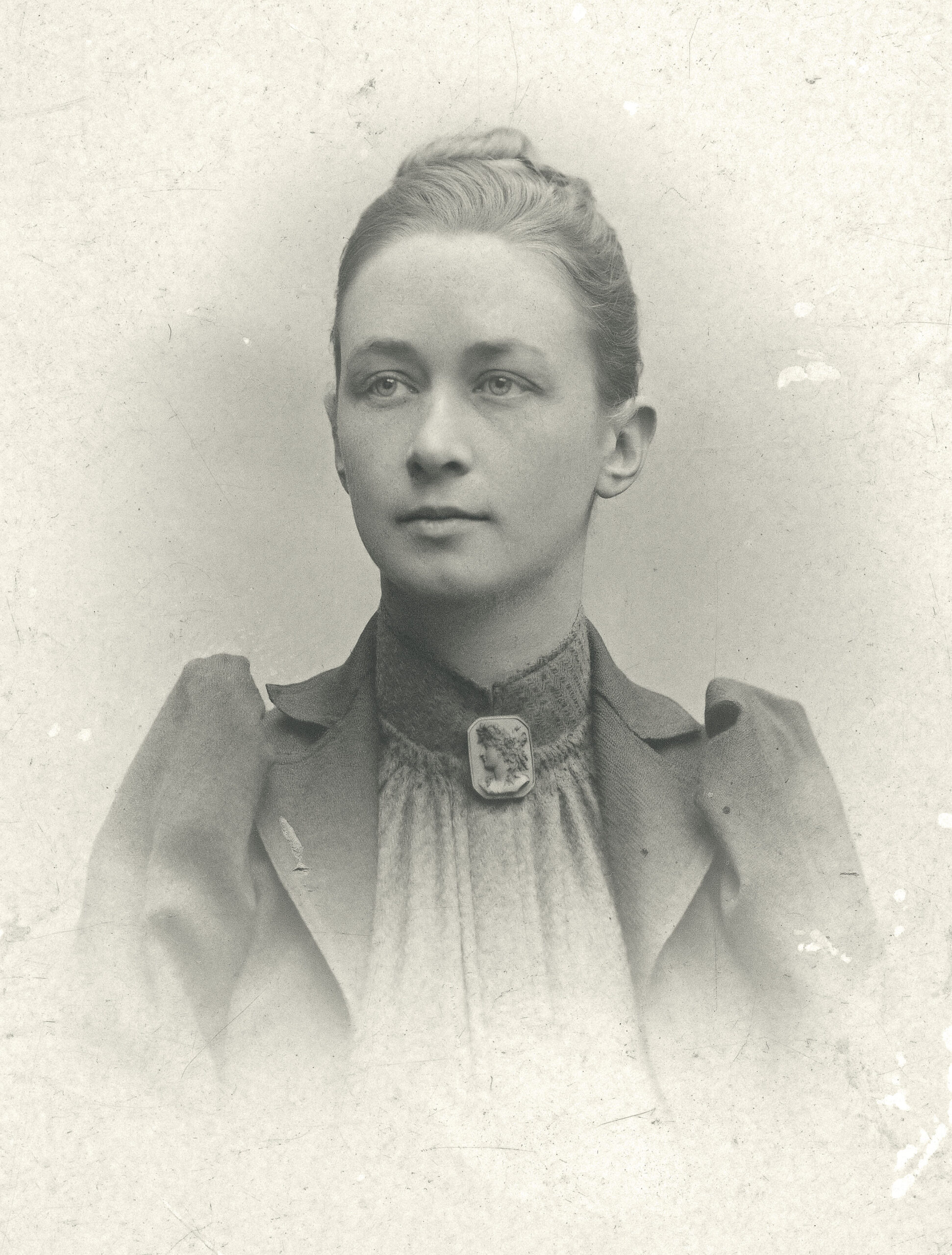
So she had a foot in the respectable art world. But she also had a second life. And that second life is where the real story begins.
The Five and the seances that changed everything
In 1896, Hilma af Klint and four other women formed a small group. They called it The Five, or De Fem in Swedish. Theosophy and spiritualism fascinated them, ideas sweeping through Europe at the time. Many serious, educated people believed you could contact higher intelligences, and these women wanted to try.
Their routine was disciplined rather than chaotic. They prayed, meditated and read from the New Testament before settling into a seance. Then they took turns acting as a medium. Each woman drew the images she said came from spirits known as the High Masters. For roughly a decade, they recorded everything in notebooks.
Out of these sessions came a turning point. A spirit she called Amaliel offered her a commission. The brief was a large body of work meant to reveal hidden truths about existence. She accepted. Whatever you make of the spiritual side, the result was a flood of images unlike anything else anyone was making.
Paintings for the Temple and The Ten Largest
The commission became her central project, the Paintings for the Temple. It is a sprawling group of 193 works made mostly between 1906 and 1915. She imagined them hanging one day in a spiral temple, a building that did not exist and that she never saw built. Still, she painted as though it did.
The most astonishing part is a subseries called The Ten Largest, completed in 1907. Each canvas stands around three metres tall. She finished the whole set in roughly forty days, helped by two friends from her circle. For paintings this scale, made this fast, the consistency is remarkable.
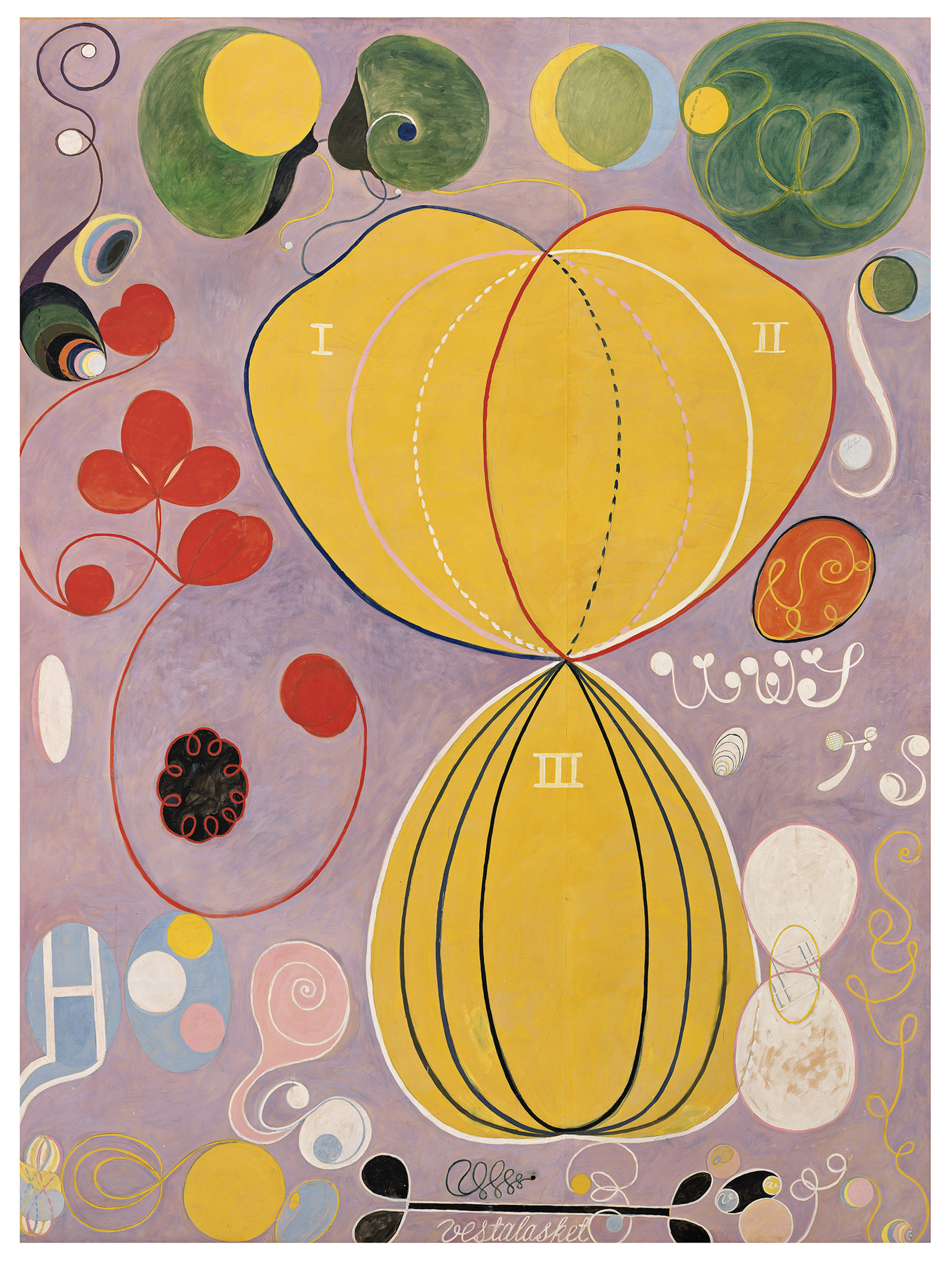
The ten paintings map the four ages of human life: childhood, youth, adulthood and old age. The colours are soft yet almost psychedelic, all peach, lilac and pale blue. Because she painted them in tempera, the surfaces have a chalky, fresco-like glow that photographs never quite capture. You really have to stand in front of them.
Look closely and motifs repeat across the series. Spirals stand for growth and evolution. The snail shell, one of her favourite forms, hints at slow development over time. Pairs of opposites appear again and again, often as overlapping discs, her way of picturing the union of male and female, or matter and spirit.
Why Hilma af Klint hid her abstract art
Here is where her story turns. Hilma af Klint suspected that her own era could not understand her work. And she may well have been right. She showed the paintings to very few people, and when she did, the response was often confusion.
One widely repeated account says she even offered her work to a major institution, which refused it. Whether or not every detail holds up, the wider point is clear: the art world simply was not ready. As a result, she made a startling decision.
In her will, Hilma af Klint instructed that the work stay hidden until at least twenty years after her death. She died in 1944, at the age of eighty-one, following a tram accident. She left behind more than 1,200 paintings. There were also an estimated 26,000 pages of notes and sketches, all waiting quietly in storage.
From obscurity to record-breaking fame
For decades, the boxes sat largely untouched. Her family eventually offered the collection to the Moderna Museet in Stockholm, though full recognition still took time. In 1986, a Los Angeles exhibition about spirituality in abstract art finally put the work before a serious audience.
Then came the moment that changed her reputation for good. In 2018, the Solomon R. Guggenheim Museum in New York opened Hilma af Klint: Paintings for the Future. It drew more than 600,000 visitors. And it became the most-visited exhibition in the museum’s sixty-year history.
Why now, though? Part of it is timing. A renewed appetite for women artists, for spirituality and for the roots of abstraction has made her work feel urgent rather than eccentric. Recent shows across Europe have kept the momentum going, and her paintings now hang beside the very names that once eclipsed her. For a painter who waited her whole life to be seen, the turnaround feels overdue.
Suddenly people were asking an uncomfortable question. If a woman in Stockholm was painting pure abstraction before Kandinsky, Mondrian and Malevich, why had the history books skipped her? Part of the answer is that she chose secrecy. Part of it, however, is that the men who wrote those histories were not looking for a female mystic from Sweden. You can see how movements get rewritten when overlooked figures resurface. The same goes for the Bauhaus, a school forced to close that still reshaped modern design.
What Hilma af Klint teaches creatives today
There is something genuinely moving about an artist who works for decades with no audience, no sales and no applause. She believed her paintings belonged to a future that had not arrived yet. So she kept going anyway. For anyone who struggles to create without instant feedback, that is a quietly radical idea.
Her life also reframes what originality looks like. She did not chase trends; in fact, she had few trends to chase, because she was inventing the form as she went. Have you ever wrestled with self-doubt? Her stubborn conviction might help, in the same spirit as our piece on beating self-doubt as an artist.
Today her canvases hang in major collections and travel the world. Institutions such as the Moderna Museet now treat her as a central figure in modern art, not a curiosity. The recognition arrived late, yet it arrived. And it turns out she was not waiting by accident. She was painting for us.
Maybe you will hear that abstract art began with one famous man in one famous year. If so, you can gently correct them. The real story is stranger, and a quiet Swedish painter named Hilma af Klint was there long before the rest.
Recommend0 recommendationsPublished in Uncategorized


Responses