
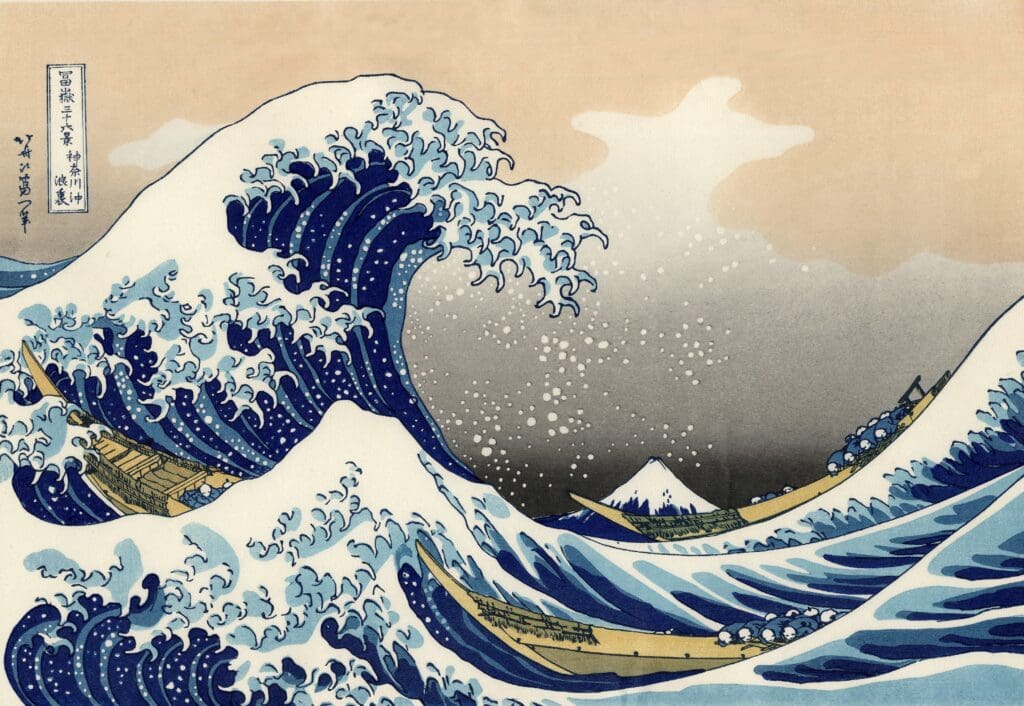
You have almost certainly seen it. On phone cases, t-shirts, tote bags, fridge magnets, even as an emoji on your phone. The Great Wave off Kanagawa by Katsushika Hokusai is one of the most reproduced images in the history of art. But for something so familiar, surprisingly few people know what is actually going on in it, or why a 70-year-old artist in an isolated island nation created something that would go on to reshape Western art.
A 70-Year-Old Artist With Nothing Left to Lose
Hokusai was born in Edo (modern-day Tokyo) in 1760, and he started drawing at the age of six. By 14 he was apprenticed to a wood-carver. By 18 he was studying under the ukiyo-e printmaker Katsukawa Shunsho. Over the course of his long career, he changed his name more than 30 times, each new name marking what he saw as a new artistic chapter.
But it wasn’t until his seventies that he produced the work he is remembered for. The Great Wave appeared around 1831 as the first print in a series called Thirty-six Views of Mount Fuji. By then, Hokusai had been through financial ruin, the death of his second wife, and the disgrace of a dissolute grandson whose debts nearly destroyed him. He was old, broke, and starting again.
That context matters. There is a restlessness in the print, a sense of something being risked. This was not an artist coasting on reputation. It was a man in his eighth decade who believed his best work was still ahead of him.
What You Are Actually Looking At
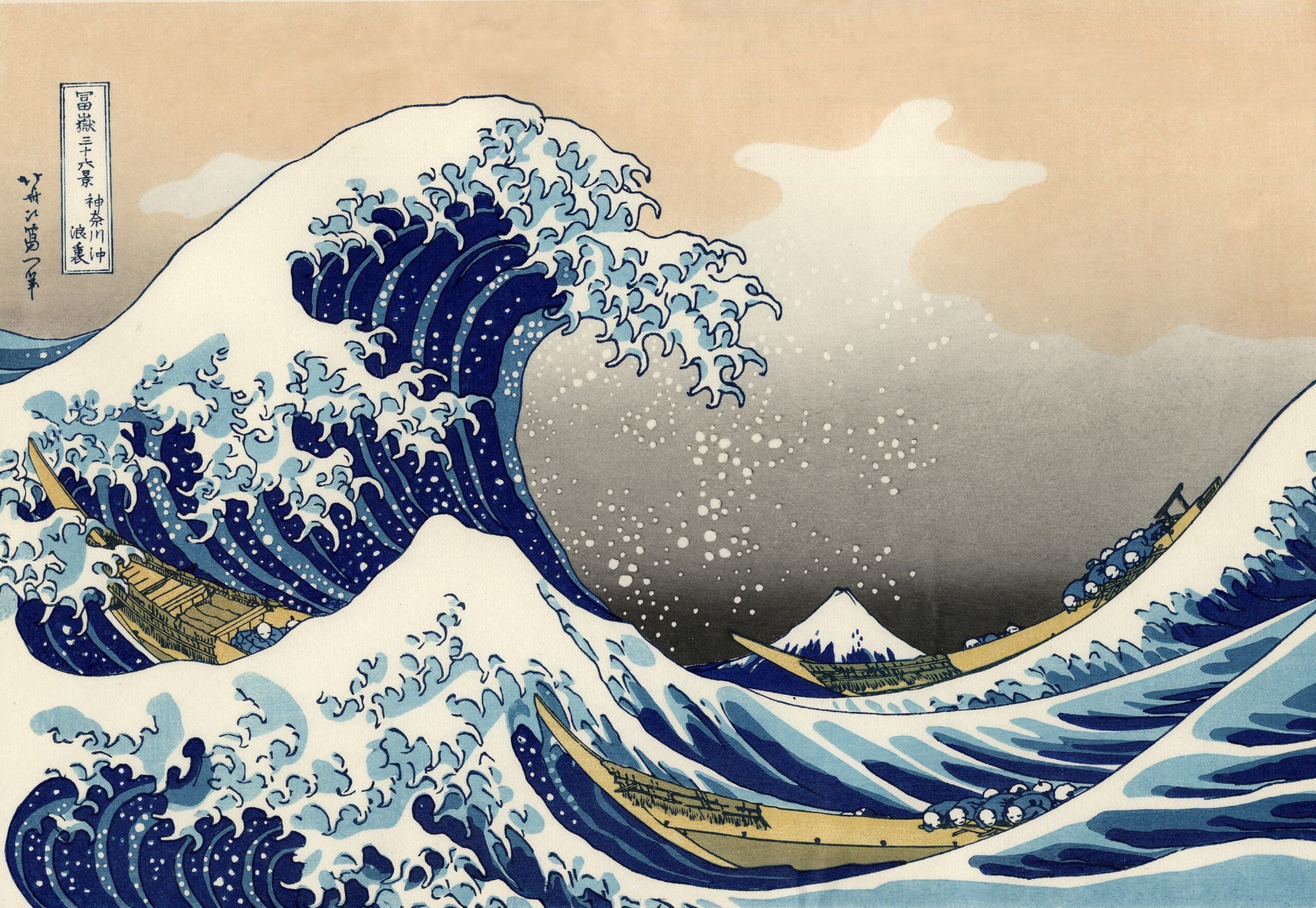
The first thing most people get wrong is the title. The print is usually called “The Great Wave off Kanagawa,” but Hokusai’s own title, printed in the upper left corner, reads Kanagawa oki nami ura. Translated literally, that means “Under the Wave off Kanagawa.” The subject is not the wave from the outside. It is the experience of being beneath it.
Look more closely and you will notice three long, narrow boats cutting through the water. These are oshiokuri-bune, fast cargo vessels that transported live fish from the Izu and Boso peninsulas to the markets of Edo. Each boat carries around eight crew members who are hunched forward, gripping the sides. They are not panicking. They are bracing, riding it out with a kind of practised calm.
And then, in the background, so small you might miss it entirely: Mount Fuji. Snow-capped and still. First-time viewers often mistake it for the crest of another wave. But it is the spiritual and compositional anchor of the entire image. The chaos of the ocean in the foreground set against the eternal stillness of the mountain. Hokusai was making a point about impermanence, about the relationship between human fragility and nature’s indifference.
The Prussian Blue Revolution
One of the most striking things about The Great Wave off Kanagawa is its colour. That deep, saturated blue was not traditional in Japanese printmaking. It came from a synthetic pigment called Prussian blue, originally developed in Berlin in the early 1700s. By the 1820s, it was being imported into Japan via Chinese and Dutch traders.
Prussian blue was cheaper and more stable than the plant-based indigo Japanese artists had been using for centuries. Hokusai saw its potential immediately. The entire Thirty-six Views of Mount Fuji series became what art historians now call his “blue revolution,” a conscious shift toward this vivid, almost electric pigment that gave his prints a depth and intensity unlike anything that had come before.
It was a foreign material, adopted by an artist in a country that had been largely closed to the outside world for over two centuries. And the resulting print would, within decades, flow right back to Europe and change the course of Western art.
Hidden Details in The Great Wave
Spend time with this print and it keeps revealing itself. The crest of the wave breaks into dozens of small fingers or claws, reaching down toward the boats as if grasping at them. Vincent van Gogh, who was an avid collector of Japanese prints, described them exactly that way: as claws. That menacing quality is not accidental. Hokusai designed the wave’s spray to evoke something predatory.
There is also the matter of scale. Using the boats as a reference, modern scholars have calculated that the wave stands somewhere between 10 and 12 metres tall. That is roughly the height of a three-storey building. And the print itself? It measures just 25 by 37 centimetres. Roughly the size of a sheet of A3 paper. The fact that something so small can convey something so overwhelming is part of its genius.
This is also not a painting. It is a woodblock print, a commercial product made for the mass market. Scholars estimate that between 5,000 and 8,000 copies were produced during its initial run, and more were printed after Hokusai’s death. The prints sold for roughly the price of a bowl of noodles. Only a few hundred survive today.
Not a Tsunami, but a Rogue Wave
People often assume the print depicts a tsunami, which makes sense given Japan’s long history with them. But scientists who have studied the image disagree. A 2013 paper published in the journal Notes and Records of the Royal Society concluded that the wave is most likely a rogue wave, specifically a “plunging breaker” caused by the convergence of multiple smaller wave trains in open water.
The researchers found that a phenomenon called directional focusing could produce exactly the kind of wave Hokusai depicted. In other words, the print may be more scientifically accurate than anyone in 1831 could have known. Hokusai was not illustrating a myth or an exaggeration. He was capturing something real, something that fishermen off the coast of Kanagawa would have understood in their bones.
How The Great Wave Conquered the West
For most of its early life, The Great Wave off Kanagawa stayed in Japan. The country’s strict sakoku isolationist policies meant very little art left its shores. But when Japan opened its ports to international trade in 1859, Japanese prints began flooding into European markets. Collectors called the trend Japonisme, and it hit the art world like a wave of its own.
Claude Monet was a passionate collector of Japanese prints and hung them throughout his home in Giverny, where you can still see them today. Van Gogh wrote to his brother Theo about the power of Hokusai’s waves. Claude Debussy was so moved by the print that he used a version of it as the cover art for his orchestral composition La Mer in 1905. The poet Rainer Maria Rilke wrote The Mountain after seeing Hokusai’s Fuji series.
Art historians have drawn a direct line between the swirling, dynamic energy of The Great Wave and the compositions in Van Gogh’s The Starry Night. The parallels are hard to miss: the intense blues, the spiralling forms, the sense of a natural world alive with movement and force.
Hokusai’s Restless Pursuit of Perfection
In 1834, three years after The Great Wave was published, Hokusai wrote a postscript to his book One Hundred Views of Mount Fuji. In it, he reflected on his own artistic life with a candour that still resonates:
“From the age of six, I had a passion for copying the form of things. By the time I was 50, I had published an infinity of designs. But all I produced before the age of 70 is not worth counting. At 73, I began to grasp the structures of birds and beasts, insects and fish, and of the way plants grow. If I go on trying, I will surely understand them still better by the time I am 80, so that by 90 I will have penetrated to their essential nature. At 100, I may well have a positively divine understanding of them, while at 110, every dot and every stroke will be as though alive.”
He signed it “Gakyojin,” meaning “Old Man Mad About Painting.” On his deathbed in 1849, at the age of 88 (or 90 by traditional Japanese reckoning), his final words were reportedly: “If heaven will extend my life by ten more years… if heaven will afford me five more years of life, then I will manage to become a true artist.”
He never reached 110. But he left behind a single woodblock print, roughly the size of a placemat, that became arguably the most famous image in Japanese history and one of the most recognisable artworks on Earth. Not bad for a man who felt he was only just getting started.
Recommend0 recommendationsPublished in Uncategorized



Responses