

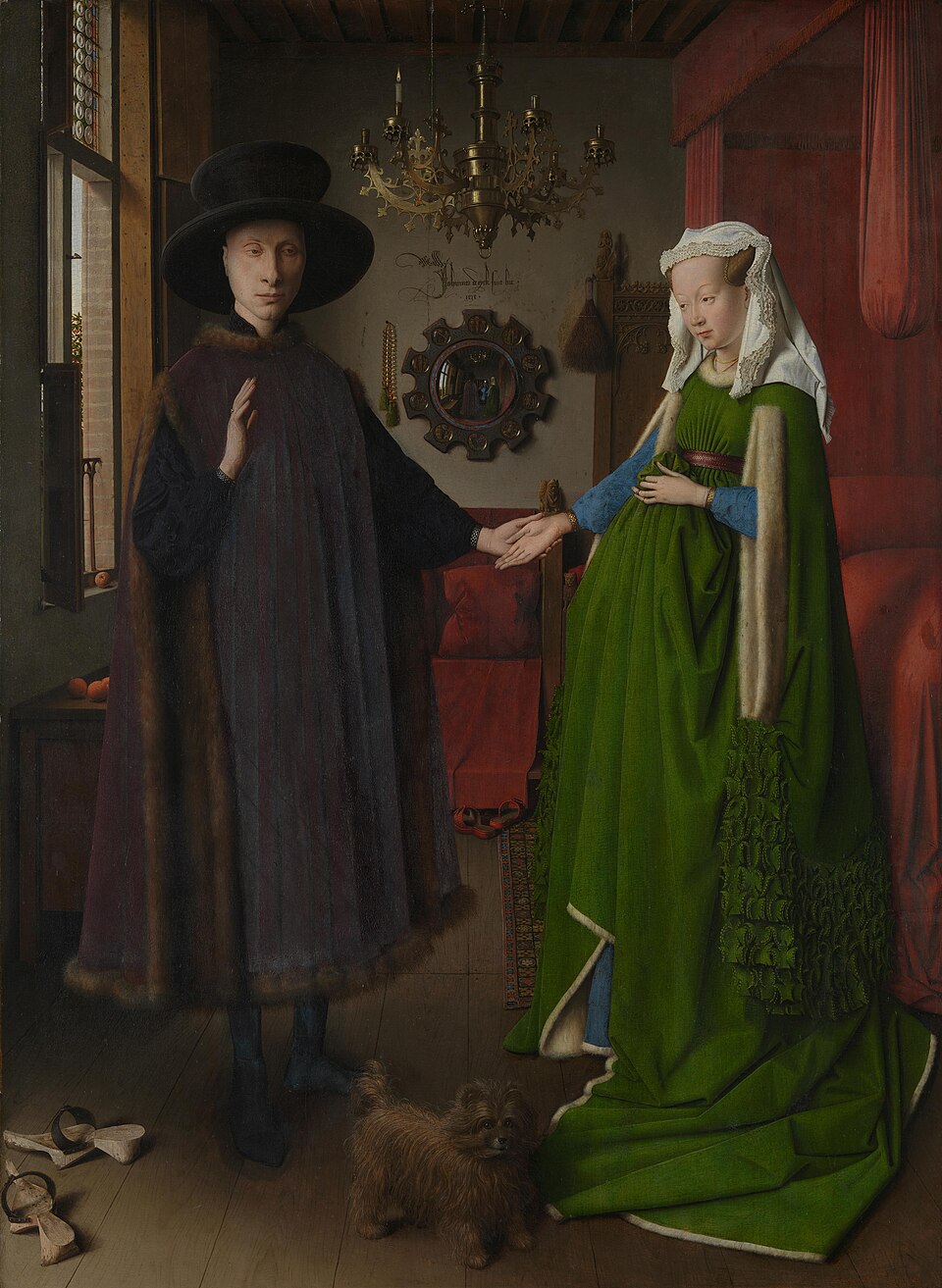
Stand close enough to the Arnolfini Portrait hidden symbols in London’s National Gallery and the painting starts to whisper. A small dog stares out. A pair of discarded clogs sits to one side. A convex mirror on the back wall holds the entire room in its bulging belly, and above it, in flamboyant Latin script, are the words Johannes de eyck fuit hic 1434. Jan van Eyck was here. But why? And what exactly did he witness?
For nearly six centuries, art historians have argued over this small oak panel, just 82 by 60 centimetres, and they still haven’t reached a verdict. The painting feels like a private moment that’s been frozen and signed by a witness who refuses to explain himself. That’s part of why people queue to see it. There’s something almost unsettling about its quiet.
A wedding, a memorial, or something stranger?
The traditional reading, championed by the German art historian Erwin Panofsky in 1934, was that the panel records a marriage. The man, Giovanni Arnolfini, raises his right hand as if taking a vow. He clasps the woman’s left hand in his. Van Eyck, in this reading, is the legal witness, and his looping signature above the mirror functions like a notary’s seal.
It’s a beautiful theory. Unfortunately, it has a problem. A document surfaced in 1997 showing that Giovanni di Nicolao Arnolfini didn’t marry Giovanna Cenami until 1447, six years after Van Eyck had already died and thirteen years after the picture was painted. So if this is a wedding, it’s not theirs.
Some scholars now think the woman is Arnolfini’s first wife, Costanza Trenta, who died in 1433, a year before the panel was completed. If that’s true, the painting becomes something stranger and sadder. Not a wedding, but a memorial. A husband commissioning his dead wife back into the room with him.
The Arnolfini Portrait hidden symbols, decoded
Whatever the occasion, the panel is packed with objects that medieval viewers would have read like a language. Van Eyck doesn’t decorate. He encodes. And once you start noticing, you can’t stop.
Take the single lit candle in the chandelier above the couple. In broad daylight, it makes no practical sense. But a single flame burning during the day was a traditional symbol of the all-seeing eye of God, often used in oath-taking ceremonies. If this is a marriage scene, that candle is the holy witness.
Or look at the oranges resting on the windowsill and the chest beneath it. In 1430s Bruges, citrus was almost obscenely expensive, imported from southern Europe by merchants like Arnolfini himself. They’re a quiet brag about wealth, but they also hint at the Garden of Eden, at fertility, and at a paradise still within reach.
And the woman’s green dress, often misread by modern viewers as evidence of pregnancy. She probably isn’t pregnant. The bulge is fashion, not biology, created by gathering enormous quantities of heavy wool fabric at the waist. Green, however, did mean something. It was the colour of hope, of new life, of the fertility a young wife was expected to bring.
The little dog at their feet
The dog is one of the most charming and most argued-over creatures in Western art. It’s an early example of the breed we’d now call an Affenpinscher, and it’s the only figure in the picture looking directly at us.
For centuries, viewers have read the dog as fido, fidelity. Loyalty. The marital virtue made flesh and fur. But others see something more earthy. Dogs in medieval imagery sometimes hinted at lust and the desire for children. The animal might be both at once. Van Eyck was rarely interested in single meanings.
What’s certain is that the dog isn’t a generic prop. It’s painted with extraordinary care, each tuft of wiry hair picked out, suggesting it was a real animal the couple actually owned. A small, living detail in a painting otherwise weighted down with symbol and ceremony.
The mirror that swallows the room
Now look at the back wall. The convex mirror, just 5.5 centimetres across, contains the whole scene reflected back. The couple from behind. The window. The ceiling beams. And, faintly, two figures in the doorway who aren’t visible in the main painting itself.
One of those figures wears red, the other blue. Many scholars believe the man in blue is Van Eyck himself, slipping into his own work like Hitchcock cameoing in a film. The Latin inscription above the mirror, Jan van Eyck was here, then takes on a documentary weight. He’s not just signing a painting. He’s recording his presence at an event.
The mirror’s wooden frame is studded with ten tiny medallions showing scenes from Christ’s Passion. They’re each smaller than a fingernail, and yet they’re rendered with the precision of an illuminated manuscript. Van Eyck was working with a magnifying glass and brushes made of a few hairs. The technical control is genuinely astonishing.
How Van Eyck changed painting forever
It’s easy to forget how new oil paint was in 1434. Van Eyck is often, slightly inaccurately, credited as the inventor of the medium. He didn’t invent it, but he refined it so dramatically that he might as well have. By suspending pigments in slow-drying linseed oil, he could build up translucent layers and capture light the way no tempera painter ever could.
This is why the brass of the chandelier glints. Why the wool of the green dress feels heavy and warm. Why the floorboards have the dusty matt finish of real timber while the mirror’s glass reflects with cold precision. Every surface in the room behaves the way it should, because Van Eyck mixed his oils to match.
You can see the echoes of this technical revolution everywhere in later art, from the Dutch Golden Age right through to the obsessive realism of certain 19th-century painters. He set a standard for what oil paint could do, and for centuries afterwards artists were still chasing him. The painting’s influence on how Western artists treated light and texture is impossible to overstate, and you can trace its long shadow even into the abstract experimentation of figures like Hilma af Klint, whose work was covered in our recent piece on the forgotten pioneer of abstract art.
Why the mystery still matters
There’s a reason the Arnolfini Portrait has its own room in the National Gallery, its own conspiracy theories, its own fan websites. It refuses to settle. Every generation of scholars asks the same questions and gets slightly different answers, because the painting was built to hold multiple meanings at once.
Is it a wedding? A memorial? A merchant’s status symbol? A devotional image disguised as a domestic scene? Probably all of these in some measure. Van Eyck wasn’t painting a moment so much as a contract between the visible world and the invisible one, with himself acting as the broker.
And then there’s the simple fact of looking at it. The hush of the room. The cool Flemish light coming through the window. The dog that meets your eye while the couple ignore you completely. It’s a painting that makes you feel like you’ve stepped through a door you weren’t supposed to open, and that’s a strange and rare feeling to get from a 600-year-old piece of oak.
If you find yourself in London with an hour spare, go and stand in front of it. The reproductions don’t really tell you the truth. In person, the surface seems to glow from within, the way old varnish does when the lighting is right. You can read more about the panel directly from the museum’s own catalogue at the National Gallery in London.
Just don’t expect the painting to give up its secrets. Six centuries in, it’s still keeping them.
Recommend0 recommendationsPublished in Uncategorized


Responses