







Few schools have shaped the way we live quite like the Bauhaus. The Bauhaus movement lasted just fourteen years, from 1919 to 1933, and yet its fingerprints are everywhere. They are in the chair you sit on, the clean sans-serif type on your phone, the flat roof of a modern office block. It began as a small art school in a struggling German town, and it ended up teaching the whole world to strip things back to what actually matters.
So how did one school manage all that in less than a decade and a half? The story is stranger, and more human, than the tidy design textbooks usually let on.
Where the Bauhaus movement began
The Bauhaus opened its doors in Weimar on 1 April 1919, founded by the architect Walter Gropius. Germany had just lost a war. The economy was in ruins, and a whole generation was looking for a way to build something better out of the wreckage.
Gropius merged two existing schools, the Grand Ducal Saxon Academy of Fine Art and the School of Arts and Crafts, into a single institution. The name he chose says a lot. “Bauhaus” roughly means “house of building”, though he flipped the usual German word order to suggest something new rather than something old.
In his founding proclamation, Gropius made a bold demand. Artists and craftsmen should stop working in separate silos. Because the ultimate goal, he wrote, was “the complete building”, a total work in which painting, sculpture and architecture came together as one. It was idealistic, a little utopian, and exactly what a broken country needed to hear.
Walter Gropius and a new kind of school
What made the Bauhaus so different was how it taught. Students did not simply sit and sketch. Instead, they started with a shared foundation course, then moved into hands-on workshops covering metalwork, cabinetmaking, weaving, pottery, typography and wall painting.
Each workshop had two teachers, and this was deliberate. One was a “master of form”, usually a fine artist, and the other a “master of craft”, a skilled technician. As a result, students learned to think like artists and work like tradespeople at the same time.
The staff list reads like a roll call of modern art. Paul Klee taught there. So did Wassily Kandinsky, Josef Albers and the Hungarian firebrand László Moholy-Nagy. These were not dusty academics. They were experimenting with abstraction and colour theory while they taught, and their ideas fed straight into the classroom. If you want to understand how those early colour experiments still shape practice today, our guide to colour theory for artists picks up many of the same threads.
Form follows function, the Bauhaus way
You have probably heard the phrase “form follows function”. It did not actually start at the Bauhaus. The American architect Louis Sullivan coined it decades earlier. But the Bauhaus took the idea and ran with it further than anyone before.
The principle was simple. An object should be shaped by its purpose, not by decoration bolted on afterwards. A teapot should pour well. A lamp should light a desk without fuss. Anything that did not serve the function was, in the Bauhaus view, just noise.
This was a direct rebellion against the swirling ornament of earlier styles. Where the Art Nouveau movement celebrated flowing decorative lines drawn from nature, the Bauhaus wanted honesty in materials and geometry you could trust. Tubular steel, flat planes, primary colours. Nothing hidden.
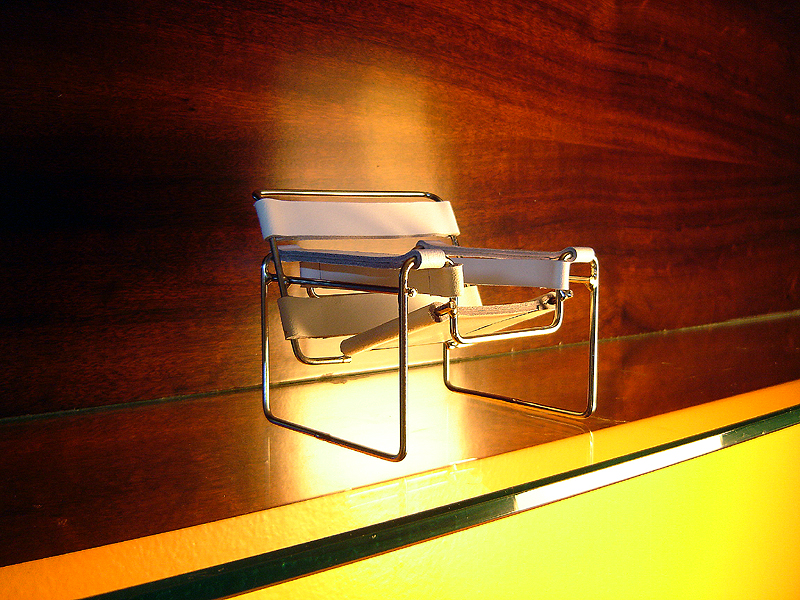
Take Marcel Breuer’s Wassily Chair. He was reportedly inspired by the handlebars of his bicycle, and he used bent tubular steel to make something light, strong and cheap to produce. It looked like nothing that had come before, and it still looks modern today.
The women who kept the Bauhaus alive
Here is a part of the story that often gets left out. The Bauhaus liked to present itself as progressive, and in its first year it did admit women on equal terms. In practice, though, Gropius quietly steered most female students into the weaving workshop, believing they could not think in three dimensions the way men could.
It was a prejudice that backfired beautifully. The weaving workshop became one of the most inventive and, crucially, one of the most profitable parts of the entire school. When the Bauhaus was scraping for money, it was often the weavers who kept it afloat.
At the centre of this was Gunta Stölzl. She joined as a student, transformed the workshop with new dyeing techniques and industrial designs, and in 1927 became the only woman ever appointed a full master at the Bauhaus. Her colleague Anni Albers described her as having “an almost animal feeling for textiles”. However, even Stölzl was not safe from the politics closing in. Students drew swastikas on her door, and she was eventually forced to leave for Switzerland in 1931.
From Weimar to Dessau to Berlin
The Bauhaus never sat still, partly because it was always under pressure. Conservative politicians in Weimar disliked its radical reputation and cut its funding, so in 1925 the school moved to the industrial town of Dessau.
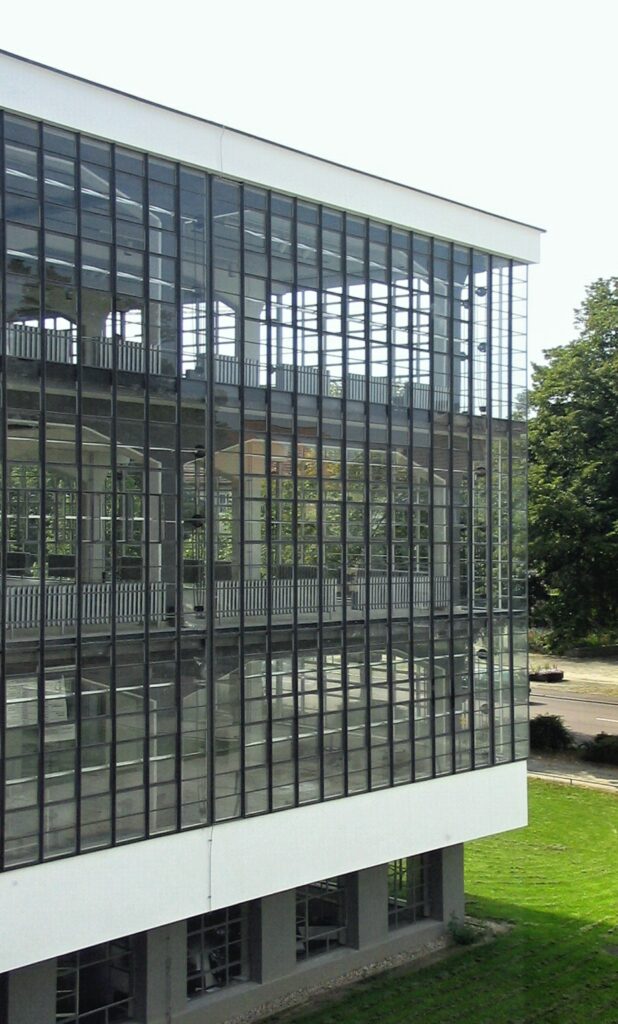
Dessau is where the Bauhaus became the image we recognise now. Gropius designed a brand new building there, all glass curtain walls and clean white geometry, and it became a manifesto in concrete and steel. In fact, that building is still a place of pilgrimage for designers, and you can read more about it through the Metropolitan Museum of Art.
Gropius stepped down as director in 1928. The architect Hannes Meyer took over, pushing the school in a more overtly political and socialist direction, which created fresh enemies. Ludwig Mies van der Rohe replaced him in 1930 and tried to steer the Bauhaus away from politics entirely.
It was not enough. The Nazis had long branded the Bauhaus a hotbed of “degenerate” and un-German ideas. After a brief final chapter in Berlin, the staff voted to close the school themselves in 1933 rather than let the regime control it.
Why the Bauhaus movement still matters
You might expect that closure to be the end. But shutting the doors was the very thing that spread the ideas across the planet. When the Bauhaus masters fled Nazi Germany, they took their thinking with them.
Gropius and Breuer ended up teaching at Harvard. Mies van der Rohe reshaped the skyline of Chicago. Moholy-Nagy founded what became the Institute of Design in that same city, sometimes called the “New Bauhaus”. Josef and Anni Albers landed at the experimental Black Mountain College in North Carolina. In effect, the school scattered its seeds worldwide.
The results are all around you. That sleek smartphone with no visible screws owes something to the Bauhaus idea of honest, functional design. So does the flat-pack furniture in your living room and the grid systems behind modern graphic design. Even the way we talk about “clean” and “minimal” design traces back to Weimar.
There is something almost moving about it. A small school in a battered country, open for barely fourteen years, quietly rewired how the modern world looks and feels. The Bauhaus movement was never really about a single style. It was about a belief that good design should be simple, useful and available to everyone, and that idea has proved impossible to close down.
For a fuller timeline and further reading, the Encyclopaedia Britannica entry on the Bauhaus is a reliable place to continue.