





For about twenty years either side of 1900, a strange and beautiful idea took hold across Europe. Art did not belong only in gilded frames. It could live in a doorknob, a lamp, a railing or a printed advert pasted to a wall. This was the Art Nouveau movement, and it tried to dissolve the line between fine art and everyday life. The results still feel fresh, because the whole point was to make the ordinary world a little more beautiful. And for a brief, dazzling moment, it worked.
So what made this style so different, and why does it keep coming back into fashion? Let us start with where it came from.
What was the Art Nouveau movement?
Art Nouveau, which simply means “new art” in French, flourished roughly between 1890 and 1910, during the optimistic years the French called the Belle Époque. The term itself first appeared in the 1880s in a Belgian journal called L’Art Moderne, and the style is often said to have taken shape in Belgium before spreading rapidly across the continent and over to America.
The movement was a deliberate rebellion. Artists and designers were tired of copying old historical styles, the endless Greek columns and Gothic arches borrowed from the past. They wanted something genuinely modern. Because of that ambition, the Art Nouveau movement reached into furniture, jewellery, glass, architecture and posters, treating decorative craft as seriously as any painting.
It went by different names in different places, which tells you how far it travelled. In Germany it was Jugendstil. In Italy, Stile Liberty. In Vienna, the Secession. The look shifted from city to city, yet the underlying spirit stayed the same.
The night that launched the Art Nouveau poster
If one image lit the fuse, it was a theatre poster made almost by accident. The story is worth telling, because it is genuinely strange.
It was the day after Christmas in 1894. A young Czech artist named Alphonse Mucha happened to be the only illustrator working at a Paris print shop when the actress Sarah Bernhardt, the first global superstar of the stage, demanded a new poster for her play Gismonda. She wanted it fast, and nobody else was available. So the job fell to Mucha.
When his design appeared on the streets on New Year’s Day 1895, Parisians were so taken with it that they peeled the posters off the walls to keep them. Bernhardt herself reportedly told him, “Monsieur Mucha, you have made me immortal.” Almost overnight he became famous, and his style became so influential that people in Paris started calling Art Nouveau simply Le Style Mucha.
What made the Gismonda poster so striking? While rivals like Toulouse-Lautrec and Jules Chéret shouted with loud colours, Mucha whispered. He chose soft greens, browns, rose and gold, and a tall, calm, almost architectural format. The figure stands still and serene, framed by flowers and Byzantine patterns. In a noisy city, stillness commanded attention.
Whiplash lines and the organic forms of Art Nouveau
You can usually spot the Art Nouveau movement in a second, even if you cannot name it. The giveaway is the line.
Designers took inspiration from nature, especially the sinuous curves of plants and flowers. They loved long, sweeping, asymmetrical curves that came to be known as “whiplash” lines, because they crack and coil like a flicked whip. Vines, lilies, peacock feathers and flowing female hair appear again and again. Nothing is rigid, and almost nothing is straight.
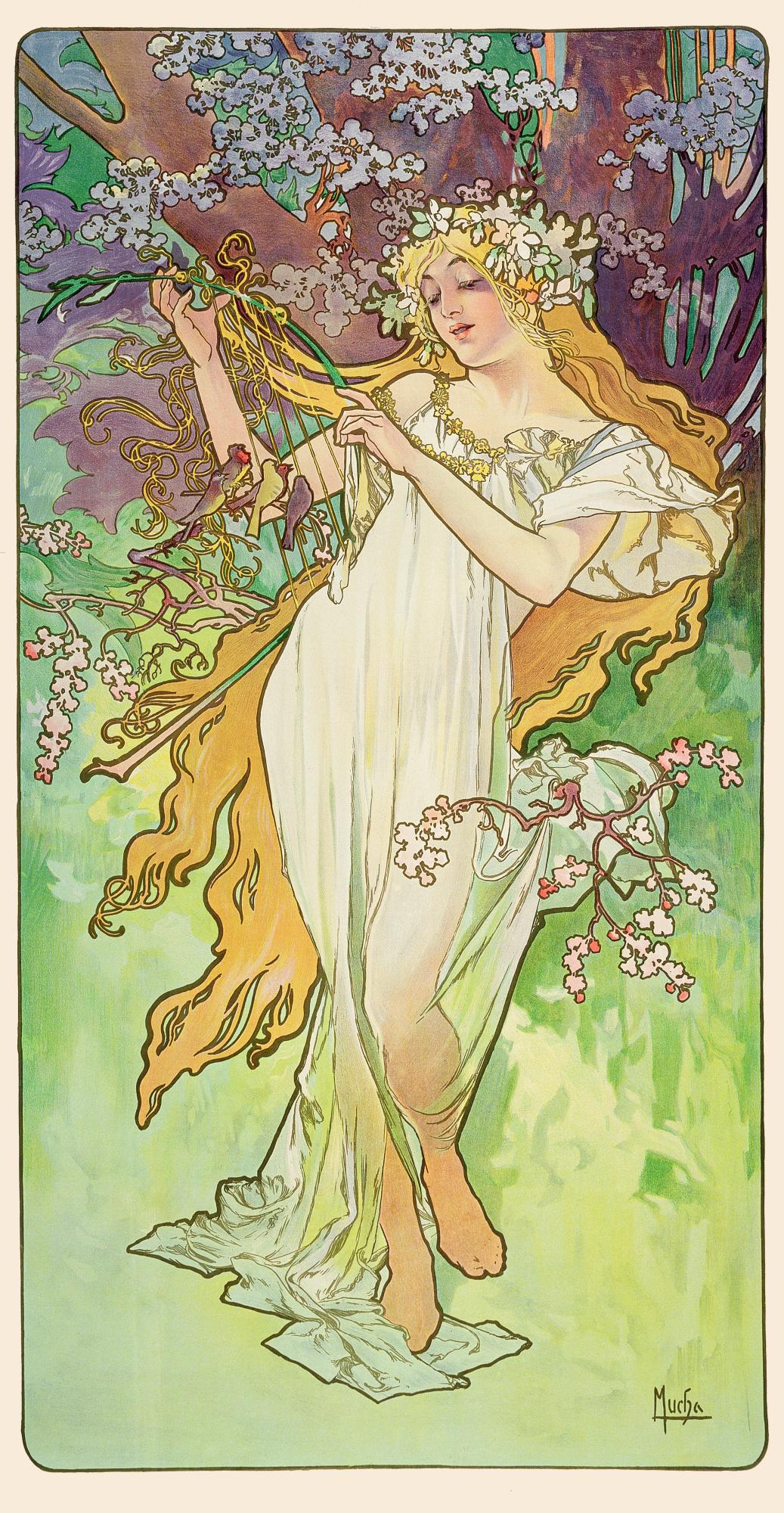
The colour palette tends to be muted and a touch dreamy. Think olive green, mustard, sage and brown, often set against violet, lilac or peacock blue. Because the movement prized craft, it also embraced modern materials, with iron, glass and ceramics bent into shapes that looked grown rather than built.
This obsession with organic form was, in part, a reaction to the machine age. As factories churned out identical goods, Art Nouveau insisted on the handmade curve and the living line. It was, in a quiet way, a protest dressed up as decoration.
Glass, iron and the architecture of a new style
The poster may be the most famous face of the movement, yet Art Nouveau was never just about prints. It spread into three dimensions, and that is where it became truly ambitious.
In New York, Louis Comfort Tiffany turned stained glass into something jewel-like, producing lamps and windows whose glowing colours still define the name Tiffany today. In Barcelona, the architect Antoni Gaudí pushed the style to its limits with buildings like Casa Milà and Park Güell, where stone seems to ripple and balconies twist like seaweed. Few buildings on earth look quite so alive.
In Vienna, meanwhile, Gustav Klimt absorbed the movement’s love of pattern and gold. After seeing Byzantine mosaics in Italy, he began his famous golden phase, layering gold leaf over swirling decorative fields. His shimmering portraits sit right at the heart of what the Art Nouveau movement could achieve in paint. This was the same restless, turn-of-the-century mood that produced other unsettling modern works, such as Edvard Munch’s The Scream, painted just as the new style was taking off.
For all its variety, the goal stayed consistent. Designers wanted a single, unified style that could shape an entire room, an entire building, an entire way of living. The French word for it was a Gesamtkunstwerk, a total work of art.
Why the Art Nouveau movement faded, and why it returned
Beautiful things do not always last. By around 1910, the style was already slipping out of fashion, and the First World War finished the job. Suddenly all those flowers and flourishes felt frivolous, even decadent, to a generation that had seen the trenches.
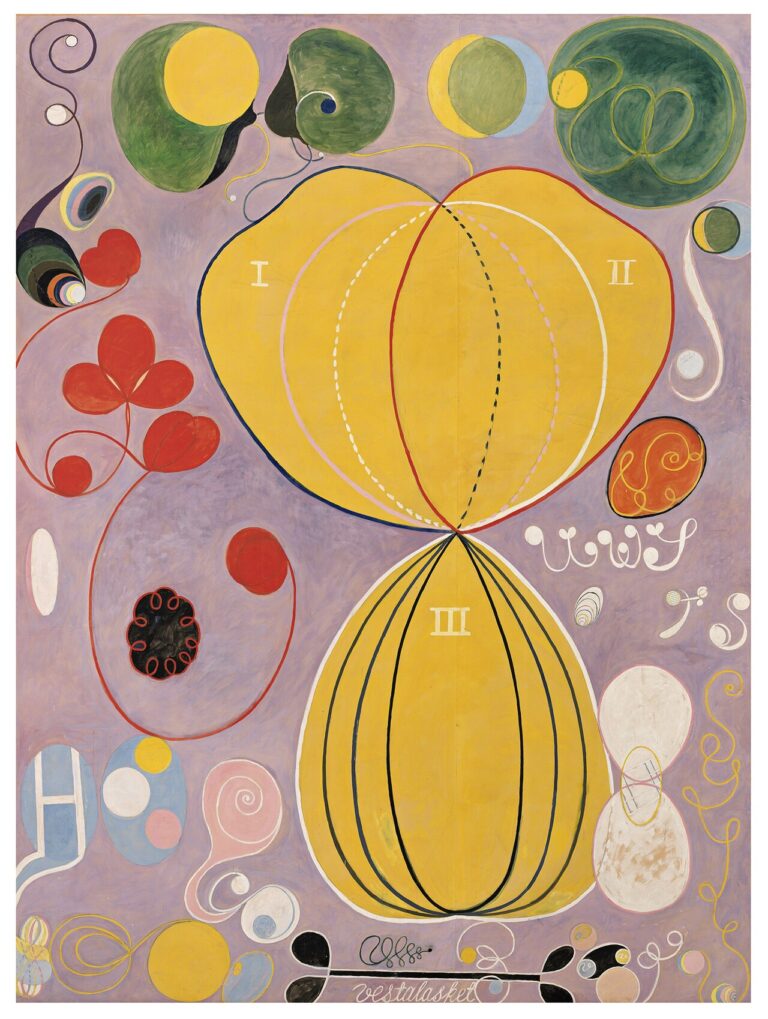
The reaction was swift. The cleaner, geometric lines of Art Deco arrived in the 1920s, and later the stripped-back honesty of Modernism declared decoration almost a crime. For decades, the whiplash curve looked hopelessly old-fashioned. Curiously, this is also when truly radical abstraction was emerging through pioneers like Hilma af Klint, whose spiritual experiments pointed art in a very different direction.
But the story did not end there. In the 1960s, Art Nouveau came roaring back. Its swirling forms and dreamy women were perfect for psychedelic concert posters, and a new generation rediscovered Mucha. Today his prints sell in their millions, and the influence shows up everywhere, from tattoo art to album covers to video game design.
The reason is simple enough. In a world of hard edges and screens, there is something deeply comforting about a style built from leaves, vines and the gentle logic of growing things. If you want to see how the movement is being reassessed today, both Britannica and The Met offer excellent overviews of its reach and legacy.
More than a century on, the Art Nouveau movement still does exactly what it set out to do. It catches your eye, slows you down, and reminds you that beauty has every right to turn up in unexpected places. Not bad for a style that began with one rushed poster on a quiet day after Christmas.