










The Great Wave off Kanagawa is probably the most recognisable image ever made in Japan, and quite possibly the most reproduced picture in the history of art. You have seen it on mugs, phone cases, tattoos and LEGO sets. But the story behind the print is far stranger and sadder than the calm blue souvenir version suggests. When Katsushika Hokusai carved this wave into being around 1831, he was a broke, grieving old man in his seventies with almost nothing to his name.

So how did a man with, in his own words, “no money, no clothing, barely enough to eat” produce something the whole world now recognises on sight? The answer says a lot about resilience, obsession, and one very unusual shade of blue.
What is actually happening in The Great Wave off Kanagawa
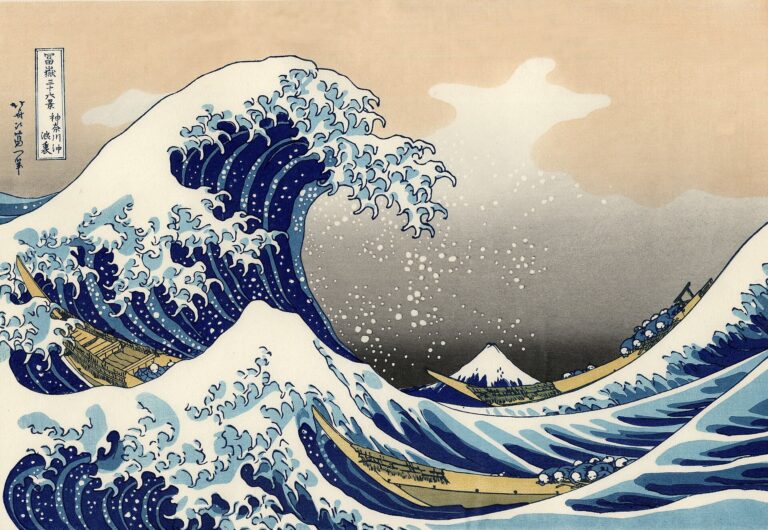
Look closely and the image is not really a single wave crashing on a beach. It shows three long boats caught in open water off the coast near what is now Yokohama. These were oshiokuri-bune, fast rowing barges that carried fresh fish from the peninsulas south of Edo, the city we now call Tokyo. The crews are hunched low, clinging on as the sea rears up around them.
And then there is the thing most people miss on a first glance. That small triangle in the background is not another wave. It is Mount Fuji, sacred and snow-capped, sitting perfectly still while chaos erupts in the foreground. Hokusai has played a quiet trick with scale here. The wave looms so large that Japan’s tallest mountain looks tiny by comparison, yet Fuji is the calm anchor the whole composition depends on.
Because of this contrast, many people read the picture as a meditation on nature’s double character. The sea is beautiful and it wants to kill you. The mountain endures because it does not fight. It simply waits the storm out.
The story behind the print and a grieving artist
Hokusai did not stumble into this image by luck. By the time he made it he had been drawing obsessively for more than sixty years, and he had changed his artist name around thirty times. He signed this very print as “Hokusai, who changed his name to Iitsu”, so even the signature tells you he was a restless man who kept reinventing himself.
The years around 1830 were brutal for him. He had suffered a stroke and treated it himself with a homemade citrus remedy. His wife had died. And his grandson was running up gambling debts that threatened to sink the entire household. Hokusai was pushing seventy and effectively starting over, because he needed the money.
The publisher Nishimuraya Yohachi commissioned a new series of landscape prints, and that series became Thirty-six Views of Mount Fuji. The Great Wave off Kanagawa was the standout. It sold well, and it helped pull Hokusai back from the edge. There is something moving about that. A frightened, penniless man in his seventies made the calmest, most controlled image of his life while his own world was falling apart.
The blue that changed everything
Part of the reason this print exploded in popularity comes down to a pigment. The deep, almost electric blue you see was a relatively new import called Prussian blue, a synthetic colour first made in Europe. Japanese printmakers had traditionally relied on plant-based blues that faded fast, but Prussian blue was cheap, stable and intense.
Hokusai’s series was among the first Japanese prints to use it heavily, and buyers had never seen colour hold like that. As a result, the whole ukiyo-e print market shifted. That vivid blue was not just a pretty choice. It was a bit of imported chemistry that gave the wave its cold, glassy menace, and it arrived at exactly the right moment.
“From the age of six I had a mania for drawing the shape of things. By the time I was fifty I had published an infinity of designs. But all I have produced before the age of seventy is not worth taking into account.”
That was Hokusai writing about himself, and it is a useful reminder. He genuinely believed his best work came late. He even claimed that if heaven granted him another decade, he might finally become a real artist.
Hidden dragons, Western influence and other details people miss
There are quieter puzzles tucked into the design. Some viewers see the claw-like foam of the wave as a dragon, a creature Hokusai returned to again and again throughout his life. Others insist the spray hanging in the air resembles skeletal fingers reaching for the boats. Once you notice it, it is difficult to un-see.
The composition itself is a clever blend of two worlds. Hokusai used European ideas about linear perspective, which is why the picture has such convincing depth, yet he kept the flat decorative patterning of Japanese tradition. For example, the wave crests from left to right, the opposite of how Japanese text was usually read. Some historians think that direction hints at the pressure of the West pushing in on a country that had kept itself closed for centuries.
If you enjoy this kind of close reading of a single image, you might like our piece on the story behind The Scream by Edvard Munch, another work whose familiar surface hides a much darker origin.
How rare is an original today
Here is where it gets surprising. This was never a one-off painting. It was a woodblock print, designed to be mass-produced, and somewhere around 5,000 to 8,000 impressions were pulled from the original blocks over time. The blocks eventually wore out, so later prints look softer and less crisp than the early ones.
Because the paper was fragile and few people treated these as fine art at first, only a small fraction survived. Recent research by a conservator at the British Museum traced and dated more than a hundred surviving first-edition impressions, scattered across museums in America, Britain, France, Japan and the Netherlands. In other words, the most famous image in the world exists in only around a hundred good early copies.
That rarity has consequences at auction. In November 2025 a well-preserved early impression sold for roughly 2.8 million dollars at Sotheby’s in Hong Kong, nearly three times its high estimate, after a bidding war that ran for eight minutes. You can see the print in person at institutions like The Metropolitan Museum of Art, which holds several impressions of its own.
Why the wave still hasn’t broken
The influence of The Great Wave off Kanagawa reaches much further than the art world. Claude Debussy kept a copy on his wall and it shaped the mood of his orchestral work La Mer. Vincent van Gogh raved about it in letters. Monet collected Hokusai prints too. And in 2024 the Japanese government put the image on a new banknote, which is a rare honour for any picture.
Maybe that is the real secret of its staying power. The wave is a single frozen instant, held forever at the edge of breaking. It never crashes, and the fishermen are never saved or drowned. We are left suspended with them, which is exactly where Hokusai wants us. A tiny mountain, a towering sea, and a moment that refuses to end.
Not bad for a broke old man who thought his best work was still ahead of him.