










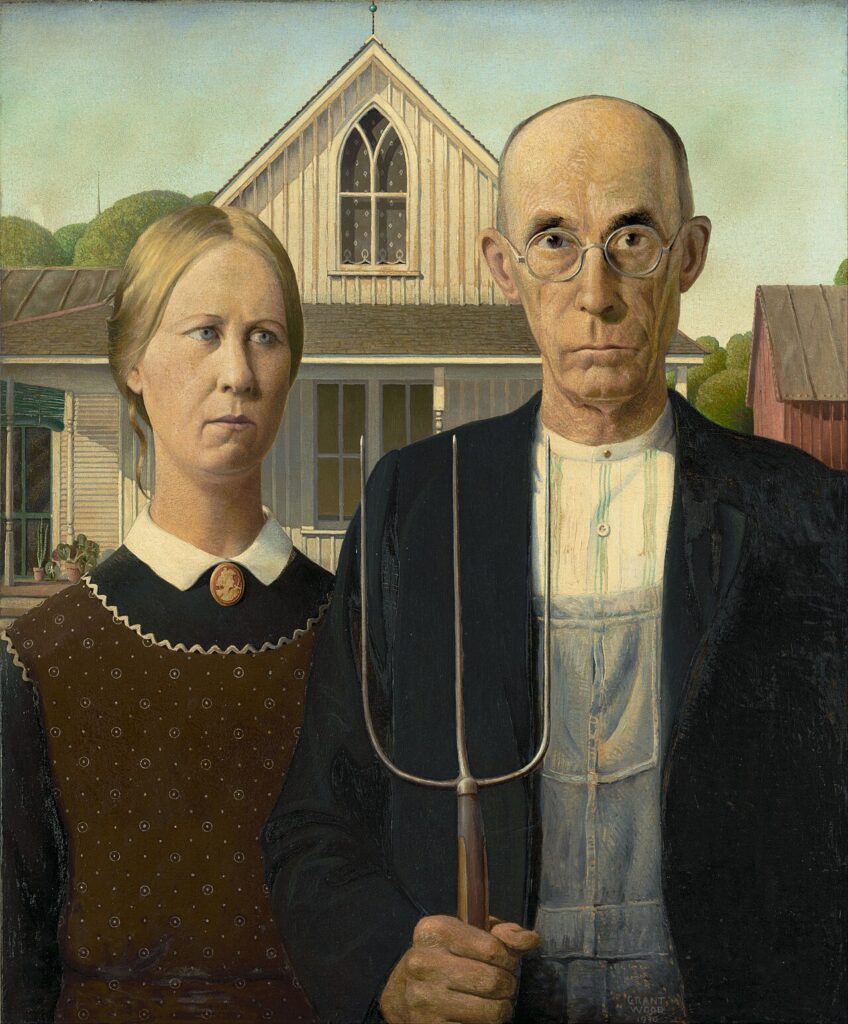

Most people who’ve seen American Gothic couldn’t tell you who’s in it. They assume the stiff, unsmiling man with the pitchfork and the woman beside him are husband and wife. Most people picture them guarding their farmhouse against the world. The story behind American Gothic is stranger than that, and a lot more personal. The man was Grant Wood’s dentist. The woman was his sister. And the painting that’s been parodied more than almost any other American artwork nearly didn’t get made at all.
Wood painted it in 1930, working on a small board rather than canvas, and it took him weeks rather than months. Nearly a century on, it’s still one of the most recognisable images in American art, reproduced on mugs, magnets, sitcoms and a 2023 Google phone advert. But the painting’s fame has always outpaced the facts about it. Here’s what actually happened.
The story behind American Gothic starts with a house, not a couple
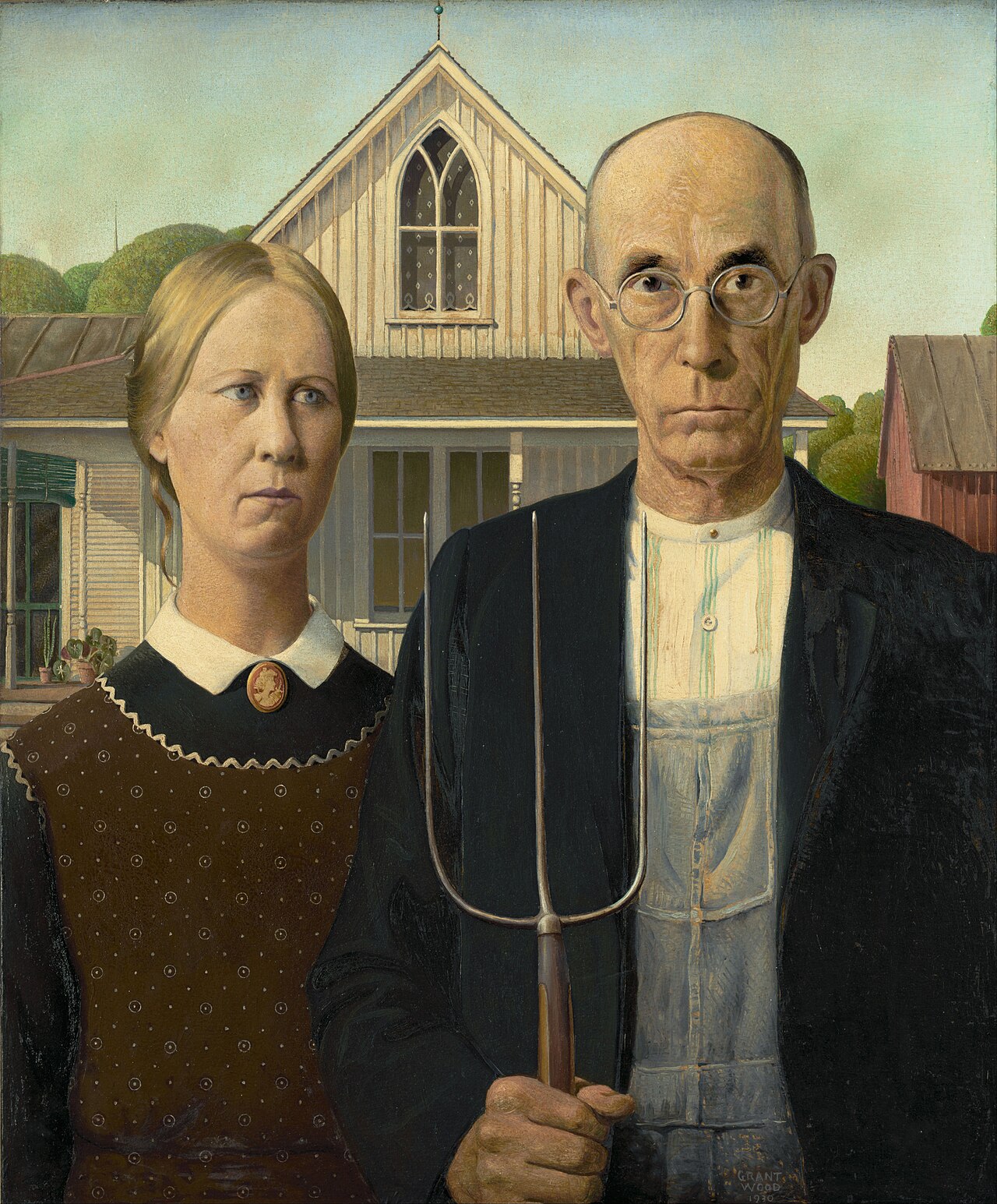
In August 1930, Grant Wood was driving through the small town of Eldon, Iowa, when a house caught his eye. It was a plain white farmhouse built in the Carpenter Gothic style. That’s a cheaper, wood framed version of the pointed arches and steep gables found on grand European Gothic cathedrals. Wood thought it was, in his own words, “very paintable.” He sketched it on the back of an envelope on the spot.
What struck him wasn’t the house itself but the mismatch. A tiny, working Iowa farmhouse wearing an architectural style meant for churches and cathedrals felt almost comic to him. He decided to paint “the kind of people I fancied should live in that house,” and only then did he go looking for models. The house came first. The people were invented to fit it.
Who are the real people in American Gothic?
Wood didn’t hire professional models. He asked his own dentist, Dr Byron McKeeby, to pose as the farmer. His younger sister, Nan Wood Graham, agreed to stand in as the woman beside him. Neither of them lived anywhere near Eldon. McKeeby sat for the face only, while Wood borrowed a pair of overalls and a local farmer’s build for the rest of the figure. Nan wore a colonial print apron with rickrack trim she’d taken from their mother’s old dresses, at her brother’s request.
Wood never explained who the two figures were meant to be to each other. Most viewers assumed a married couple, which irritated Nan for the rest of her life. It wasn’t until 1941, eleven years after the painting was finished, that Wood clarified it in a letter: “the prim lady with him is his grown-up daughter.” By then the misreading had already taken hold, and it’s still the version most people carry around in their heads.
Grant Wood’s American Gothic meaning: satire or celebration?
This is where the story gets genuinely contested, and where art historians still disagree. When the painting was first shown, at the Art Institute of Chicago’s annual exhibition in 1930, one judge on the jury dismissed it as a “comic valentine.” A museum trustee disagreed strongly enough to fight for it, and the painting won a bronze medal, a $300 prize, and a place in the museum’s permanent collection soon after.
Iowans took it personally. When a Cedar Rapids newspaper ran the image, letters poured in. They accused Wood of mocking his own state, painting its people as pinched, grim, humourless Bible thumpers. One farmer’s wife reportedly threatened to bite his ear off. Wood always denied that satire was the point. He had recently returned from studying in Europe, and said the trip had taught him something: “I had to go to France to appreciate Iowa.” His aim, he insisted, was closer to affection than mockery, a tribute to the kind of dogged, old fashioned resilience that Depression era America badly needed to see reflected back at it.
Later critics have never fully settled the question. Gertrude Stein and Christopher Morley read it as satire from the start. Depression era audiences, by contrast, often saw pioneer grit in the same two faces. More recent scholars have gone further still. One 2019 analysis proposed a mythological reading involving Pluto and Proserpina, and another argued that the closed curtains and the woman’s black dress point to a Victorian mourning portrait rather than a farmhouse snapshot. Nobody has landed on a single accepted answer, and that’s probably part of why the painting still gets written about nearly a hundred years later.
The hidden details people miss in American Gothic
Look past the two faces and the painting rewards a closer read. The three pronged pitchfork in the man’s hand isn’t a random prop. Wood repeats its shape on purpose: in the stitching on the man’s overalls, in the Gothic window behind him, and arguably in the long lines of his own face. It’s a small, precise piece of visual rhyming that’s easy to miss on a phone screen but obvious standing in front of the actual painting.
The porch behind the pair holds houseplants that Wood chose carefully rather than decoratively: mother in law’s tongue and a beefsteak begonia. Both are hardy, unfussy plants, suited to people who wouldn’t waste time on anything delicate. The house itself, the one Wood spotted from his car, still stands in Eldon. It’s now a small museum you can visit, sitting almost exactly as it did in 1930, right down to the gothic window.

How American Gothic became the most parodied painting in America
Few artworks have been borrowed, mocked and reworked as often as this one. Photographer Gordon Parks referenced it in 1942 for his portrait of government cleaner Ella Watson, swapping the pitchfork for a mop and the farmhouse for an American flag. It was a sharp comment on race and labour that used Wood’s own composition against itself. Since then the pose has turned up in The Simpsons, King of the Hill and Desperate Housewives. It’s also on countless magazine covers, birthday cards and tourist photos taken by couples standing in front of the real farmhouse in Eldon.
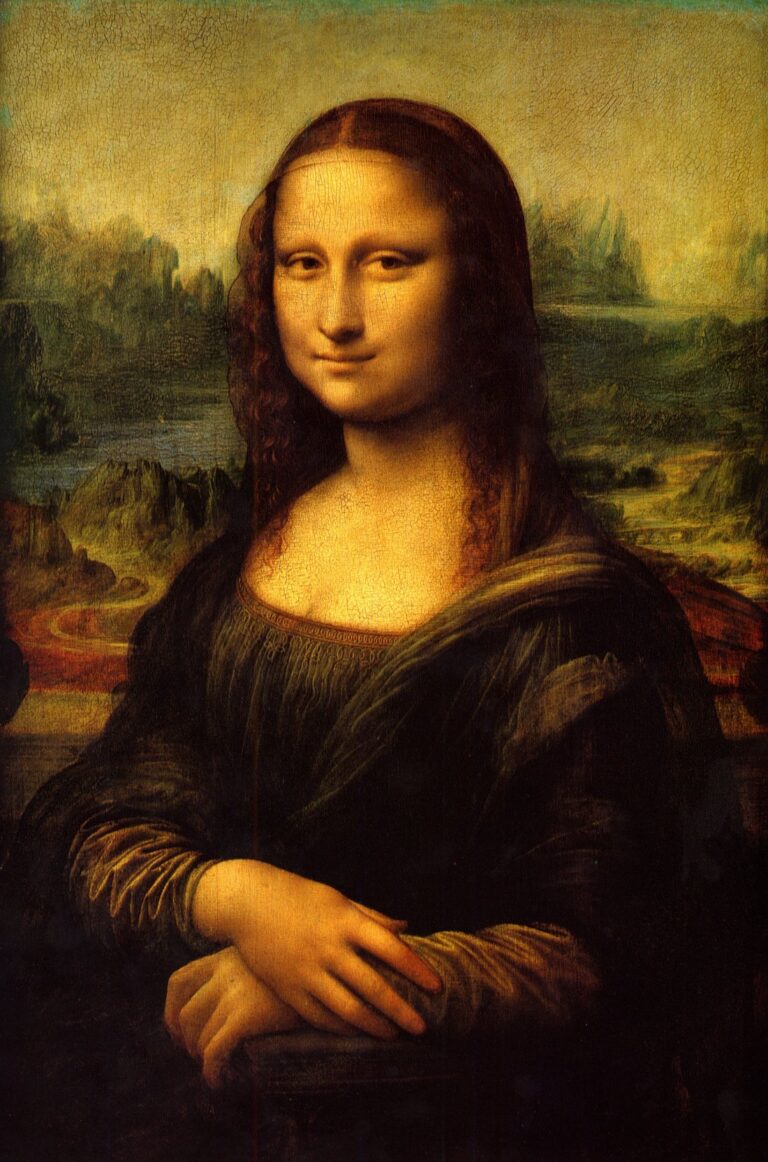
That afterlife says something the original controversy never quite settled. A painting that started as a fairly quick study of a house and two borrowed faces has become a kind of template that every generation redraws to say something new about American identity. Much like the theft that turned the Mona Lisa into a household name, it’s often the story around a painting, as much as the painting itself, that cements its fame.
Nan Wood Graham, the sister in the painting, spent much of her later life trying to control that afterlife. In 1977, by then in her seventies, she and a friend sued Hustler magazine over a topless parody of the painting. They argued it damaged her brother’s reputation as well as her own. The case dragged on for years, and a court eventually ruled against her in 1984. Even so, she never stopped objecting to versions she felt were disrespectful. She once said she simply wanted people to see the painting the way her brother intended it, not as a joke at his expense.
The original painting still hangs at the Art Institute of Chicago, where it has lived since Wood sold it directly to the museum in November 1930. If you want to see where it all began, the American Gothic House in Eldon is open to visitors, pitchfork poses included.
Next time it turns up on a mug or a meme, it’s worth remembering there’s a real dentist and a real, slightly exasperated sister behind those two faces. Grant Wood never meant for them to become symbols of anything. He just thought the house was worth painting, and needed two people who looked like they belonged standing outside it.




Responses