











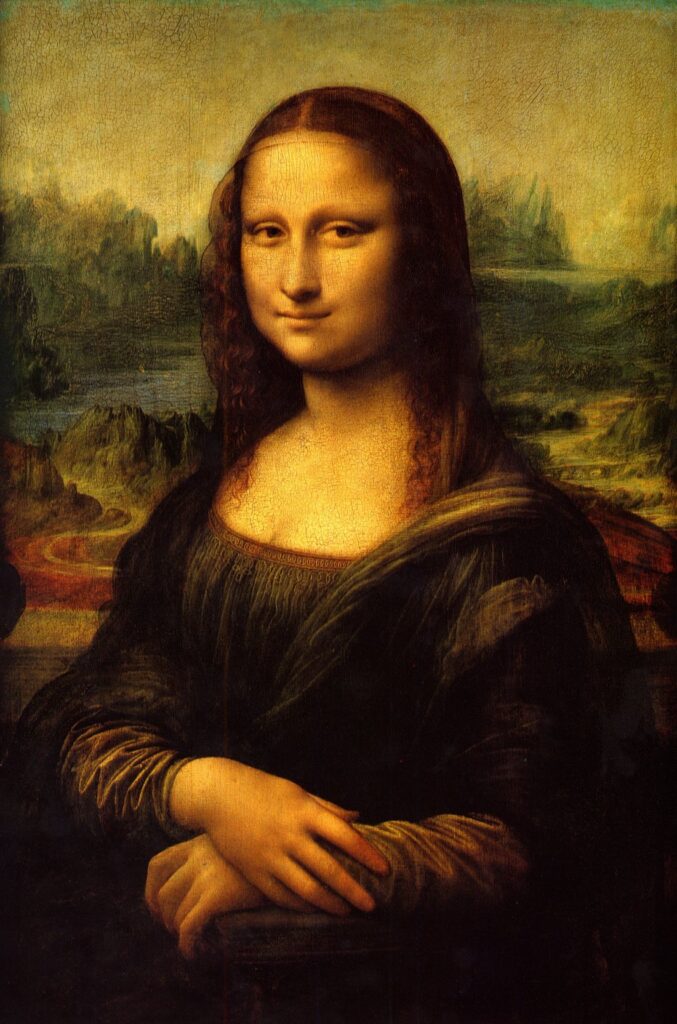

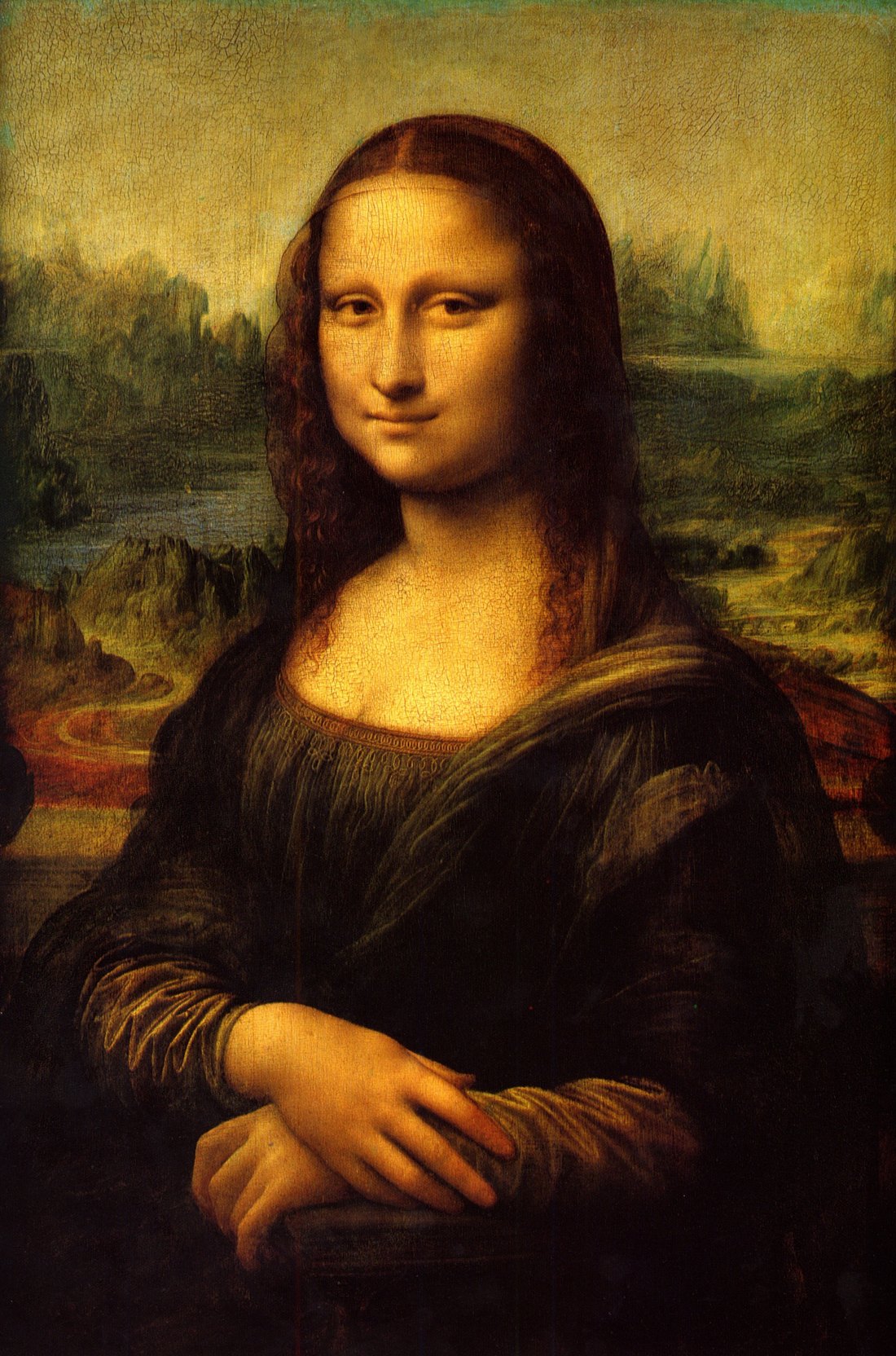
On a quiet Monday in August 1911, a man in a white workman’s smock walked out of the Louvre. Under his arm was Leonardo da Vinci’s Mona Lisa. Nobody stopped him, and nobody noticed the painting had gone for more than a day. The Mona Lisa theft is still the strangest art crime on record, partly because it was so easy, and mostly because of what it did to the painting afterwards.
Here is the part most people get wrong. Before 1911, the Mona Lisa was not the most famous painting in the world. Critics admired it and artists studied it. But it was not the picture that millions queue for today. The theft changed that.
What Happened on 21 August 1911
The Louvre closed to the public on Mondays. Cleaners, glaziers and photographers had the run of the place. A man in a white smock was simply part of the furniture.
That morning, Vincenzo Peruggia walked into the Salon Carré and lifted the Mona Lisa off its four iron pegs. He carried it to a service staircase, where he prised the panel out of its frame and its protective glass case. Both were left on the stairs. Then he tucked the poplar panel under his smock and walked out.
The whole Mona Lisa theft took minutes. Leonardo painted the picture on wood, not canvas. It weighs about eight kilograms and measures roughly 77 by 53 centimetres. Small enough to carry, and small enough to hide.
The Man Behind the Mona Lisa Theft
Peruggia was an Italian decorator and glazier, born in 1881 near Varese. He had worked at the Louvre. He had even helped fit the glass case that was meant to protect Leonardo’s panel. In other words, the museum had shown him how to undo its own security.
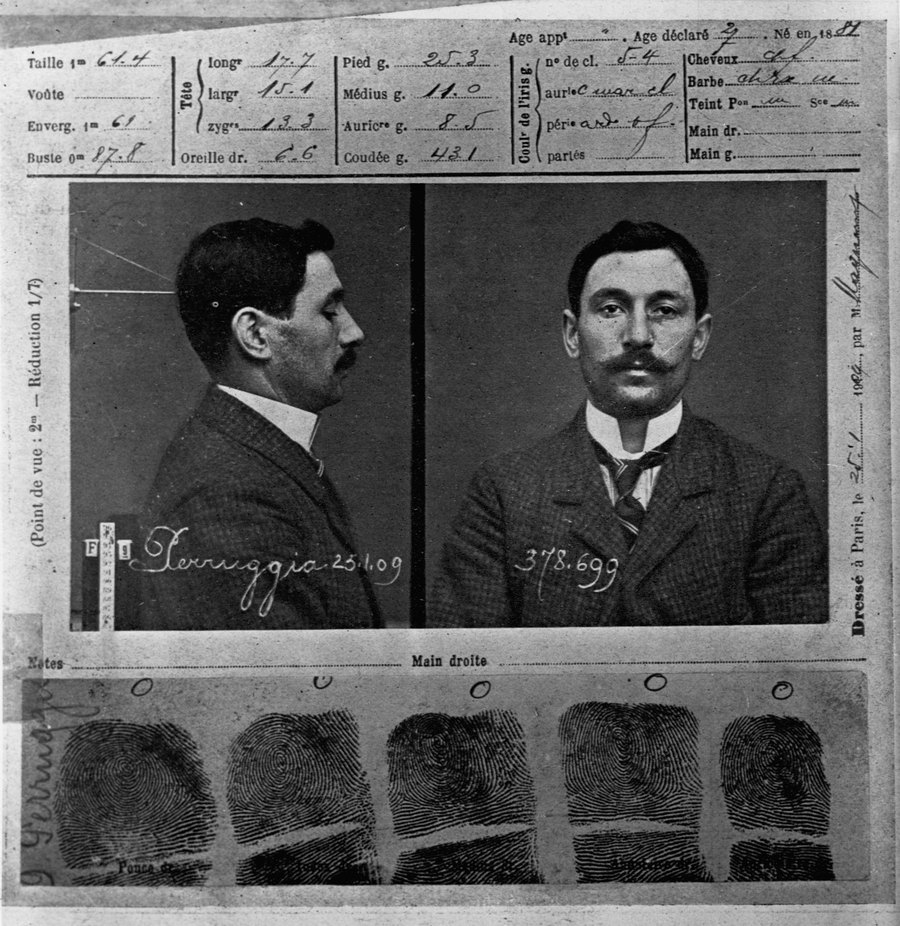
He always insisted his motive was patriotic. Napoleon had looted the painting from Italy, he claimed, so he was simply taking it home.
That story falls apart on contact with the facts. Leonardo carried the portrait to France himself in about 1516, and King François I acquired it. No looting, no theft, just a very old French receipt.
An Empty Wall and a Public Panic
The alarm was raised the next morning, and not by a guard. The painter Louis Béroud arrived on 22 August to work in the Salon Carré. He found four bare pegs where Leonardo should have been.
Staff assumed the photographers had it upstairs. Only when nobody could produce it did anyone call the police. By that evening, news of the Mona Lisa theft was on the wires.
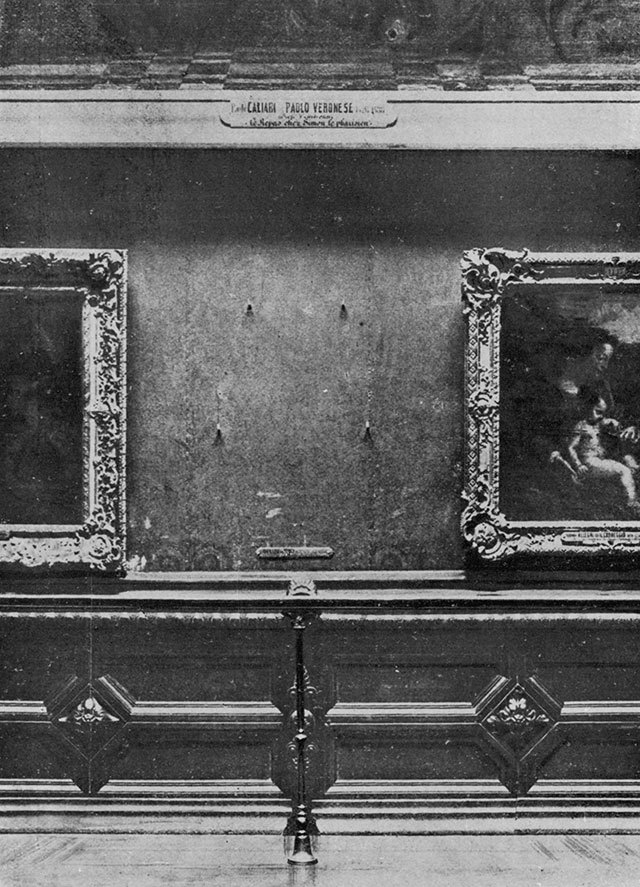
The Louvre shut for about a week. When it reopened, something odd happened. People queued around the block, not to see art, but to look at an empty wall. Newspapers printed the gap on their front pages. The absence became the attraction.
France was humiliated. The museum’s director lost his job. Meanwhile the press treated the loss as a national wound rather than a property crime.
Picasso Was Questioned by the Police
The investigation went sideways almost immediately. In September 1911, police arrested the poet Guillaume Apollinaire. He had a loose connection to an earlier case involving small Iberian statues taken from the Louvre.
Under questioning, Apollinaire named his friend Pablo Picasso, who had bought two of those statues. Police hauled Picasso in. By most accounts he denied knowing the poet at all, then backtracked.
Both men walked free. It was a humiliating episode for two giants of modern art, and it shows how badly the police were flailing.
Two Years in a Wooden Trunk
Meanwhile the painting sat in Peruggia’s small Paris room, in a trunk with a false bottom, buried under his clothes. Police had actually interviewed him during a sweep of former employees. They found nothing suspicious and moved on.
The Mona Lisa theft could have ended there. Instead he waited more than two years. Then, in late 1913, he wrote to Alfredo Geri, an antiques dealer in Florence. He offered to bring the Mona Lisa back to Italy, signed himself “Leonardo”, and asked for half a million lire.
Geri, sensibly, brought in Giovanni Poggi, the director of the Uffizi. On 10 December 1913, in a Florence hotel room, Peruggia opened the trunk and produced the painting. Poggi checked the panel against the Louvre’s inventory marks on the back.
Police arrested Peruggia the following day. Italy, briefly, went slightly mad with joy.
Why the Mona Lisa Theft Made the Painting Famous
Before it went back to Paris, the panel toured Italy in triumph. It hung at the Uffizi, then travelled to Rome and Milan, drawing enormous crowds. It returned to the Louvre on 4 January 1914.
Peruggia’s punishment was light. He served roughly seven months. Plenty of Italians treated him as a folk hero rather than a criminal.
The historian Donald Sassoon put it bluntly. Peruggia took the Mona Lisa not because it was the most famous painting, but because it was small. Fame arrived later, manufactured by two years of headlines in every language on earth.
That is the uncomfortable lesson of the Mona Lisa theft. A painting’s reputation is not fixed by quality alone. Reproduction, scandal and sheer repetition do a great deal of the work. It is worth remembering that whenever someone tells you the market simply recognises greatness, and our piece on why modern art costs so much runs into the same problem from another angle.
The Story That Probably Is Not True
The Mona Lisa theft has also attracted one very persistent legend. You will often read that Peruggia was a pawn. In this version, an Argentine confidence trickster called Eduardo de Valfierno commissioned the theft. He then sold six forged copies to collectors, each believing they had the original.
It is a wonderful story. It also rests on one article by the American journalist Karl Decker, published in the Saturday Evening Post in 1932. That was seven years after Peruggia died.
No forgeries ever surfaced. No independent record of Valfierno exists. Decker had a reputation for colouring things in. So treat it as folklore, in the same family as the tales around the Gardner Museum heist.
The Louvre Is Still Learning the Lesson
In October 2025, thieves used a truck-mounted lift to reach a first floor window of the Apollo Gallery. They smashed display cases and took eight pieces of French crown jewellery. They were inside for roughly four minutes, and the haul was valued at around 88 million euros. None of it has been recovered.
The parallels with 1911 are hard to miss: builders’ clothing, broad daylight, and cameras pointing the wrong way. The museum’s director resigned. Since then the Louvre has added about a hundred cameras and bars on ground floor windows.
As for Leonardo’s sitter, she is finally getting somewhere quieter. Under the Louvre Nouvelle Renaissance plan, the Mona Lisa will move to a purpose built room beneath the Cour Carrée. It will have its own entrance and its own ticket, from the early 2030s.
A century after a glazier walked off with her, the museum is still redesigning itself around the consequences.
What the Theft Teaches Artists
There is a practical takeaway in the Mona Lisa theft, and it has nothing to do with security. Peruggia handed the Mona Lisa a story, and the story travelled further than the picture ever could.
Work does not spread on quality alone. It spreads because people can retell it, argue about it, and recognise it in a newspaper at a glance. That is not cynicism. It is simply how attention has always moved.
So if your paintings are good and nobody knows them, the problem is probably not the paintings.
Where to See the Mona Lisa Now
She hangs in the Salle des États, behind bulletproof glass, inside a climate controlled case. Around 20,000 people file past on a busy day, and most get less than a minute.
If you go, do yourself a favour. Look at the landscape behind her shoulders, where the horizon sits at two different heights. Look at the way the corners of the mouth dissolve into shadow. That is the painting Peruggia stole. The rest is publicity, and he supplied a good deal of it.





Responses